A Guide for Colleges to Support Child Care for Parenting Students
Nearly 1 in 5 undergraduates are parents. There are more than 3 million undergraduate and 1 million graduate parenting students in US colleges. Although parenting students earn GPAs similar to those of their peers without children, only 17 percent complete a degree within six years. Parenting students frequently identify child care as one of the supports they most need to stay enrolled. But constraints on child care supply, quality, and affordability limit what colleges can offer. This guide helps colleges explore a range of child care options in light of parenting students’ specific needs. It also examines approaches such as drop-in care and child care grants, which can offer more flexibility than traditional full-time, on-campus care.
How to Cite This Guide:
Kate Westaby,1 Eileen Chanti,2 Kevin Relf,2 Kimberly Salazar,1 Theresa Anderson,1 and Renee Ryberg.3 2026. A Guide for Colleges to Support Child Care for Parenting Students. Student-Parent Action through Research Knowledge.
1 Urban Institute
2 Skills and Training in Action Research (STAR) Fellow, Urban Institute
3 Ithaka S+R (formerly Child Trends)

About the Guide
How and why we created the guide, acknowledgments

Assessing Needs
College, system, or state-level assessments of child care and parenting students' needs

Care Options
Child care types (e.g., centers, drop-in care, event-based care)

Funding
Federal, state, private, and Oregon-specific funding sources

Partnerships
Types of partnerships with child care providers and community organizations, and how to build them

Key Considerations
Making the case, licensing, staffing, waitlists, administrative burden, children on campus, and rural, online, and part-time students
This guide outlines practical considerations and promising models for colleges seeking to support child care for parenting students. The work began with a focus on Oregon, but as it progressed, we found that the issues and approaches had national relevance. The guide is therefore written for a national audience, though many examples and some funding sources are specific to Oregon.
We developed the content through interviews and group discussions with 44 national and Oregon-focused experts on child care and higher education. We also engaged members of the Oregon Association for the Education of Young Children, who provided insights and feedback on child care approaches and considerations. We are particularly grateful to Amy Luhn, Kristi King, Robin Taylor, and Ann Reynolds for their considerable guidance and support.
The Ford Family Foundation funded this project, and we are grateful for its support.
Updated: October 2026
Questions, suggestions, or corrections may be directed to Kate Westaby at kwestaby@urban.org.
The authors used Claude Opus 5.5, an AI model made by Anthropic, to check and edit the content of this guide and to draft some text. The authors are responsible for all material.
No results match your filters.
Colleges and universities can offer many kinds of child and youth care for parenting students, from operating child care centers directly to partnering with community organizations or providing grants or stipends. Assessments can help colleges identify gaps in child care and understand what parenting students need. The resources below help states, college systems, and individual colleges take stock of child care offerings and parenting students' needs.
An Assessment of College Child Care and Early Childhood Education Offerings: A Tool for State Agencies, College Systems, and Regional Organizations collects information about child care, youth, and early childhood education (ECE) offerings at colleges and universities across a system, state, or region. Respondents report on every type of care their college provides (e.g., center-based, after-school, or drop-in care), including operational details, partnerships, the ages of children served, and the purpose of each offering. The assessment also asks about related academic programs (e.g., ECE degrees), campus policies on children, other supports for parenting students, planned expansions, and challenges. The goal is to document what exists, whether it serves parenting students, and where gaps remain.

Check out the assessment tool!
Click here to explore the assessment.
How to Cite This Assessment:
Kate Westaby. 2026. An Assessment of College Child Care and Early Childhood Education Offerings: A Tool for State Agencies, College Systems, and Regional Organizations. Urban Institute.
Acknowledgments:
This assessment was developed with support from The Ford Family Foundation and with feedback from the following partners: Eileen Chanti (STAR Fellow, Urban Institute), Ann Reynolds (Mount Wachusett Community College), Theresa Anderson (Senior Fellow, Urban Institute), Renee Ryberg (Ithaka S+R), Kevin Relf (STAR Fellow, Urban Institute), Kimberly Salazar (Research Analyst, Urban Institute), Amy Luhn (Oregon State University), Robin Taylor (Chemeketa Community College and ORAEYC) and Kristi King (Oregon State University).
To implement An Assessment of College Child Care and Early Childhood Education Offerings, we recommend the following:
Preparing
- Adapt the assessment to:
- The relevant state context. States administer federal Child Care and Development Fund (CCDF) dollars, so the funding sources listed in the assessment should reflect those available in your state.
- The college system or local context. College child care experts in your state or region may suggest useful additions or changes. We recommend piloting the assessment with local child care experts, who can walk your team through how they would answer the questions and identify what might be missing for their context.
- Program the assessment in software with advanced functionality (e.g., Qualtrics, Voxco, QuestionPro, or SurveyMonkey). The assessment uses extensive skip logic to reduce burden, as well as looping (i.e., colleges answer the same set of questions once for each care offering they report). Basic platforms such as Google Forms lack these features unless the assessment is substantially shortened.
- Provide a Word version so respondents can preview the questions and gather input before entering responses online.
Recruiting
- Ask each college to designate one respondent to avoid duplicate responses from the same college.
- Engage existing college and child care networks for recruitment and review. For example, independent college associations or community college systems can encourage their members to participate.
- Let potential respondents know that the Word version looks long because of the skip logic, but entering responses in the online survey takes about 30 minutes. In Oregon, colleges with limited or no child care offerings finished in 5 to 10 minutes.
- Consider keeping the online survey open past the deadline if you are still missing responses.
Assessment of Oregon Child Care Offerings
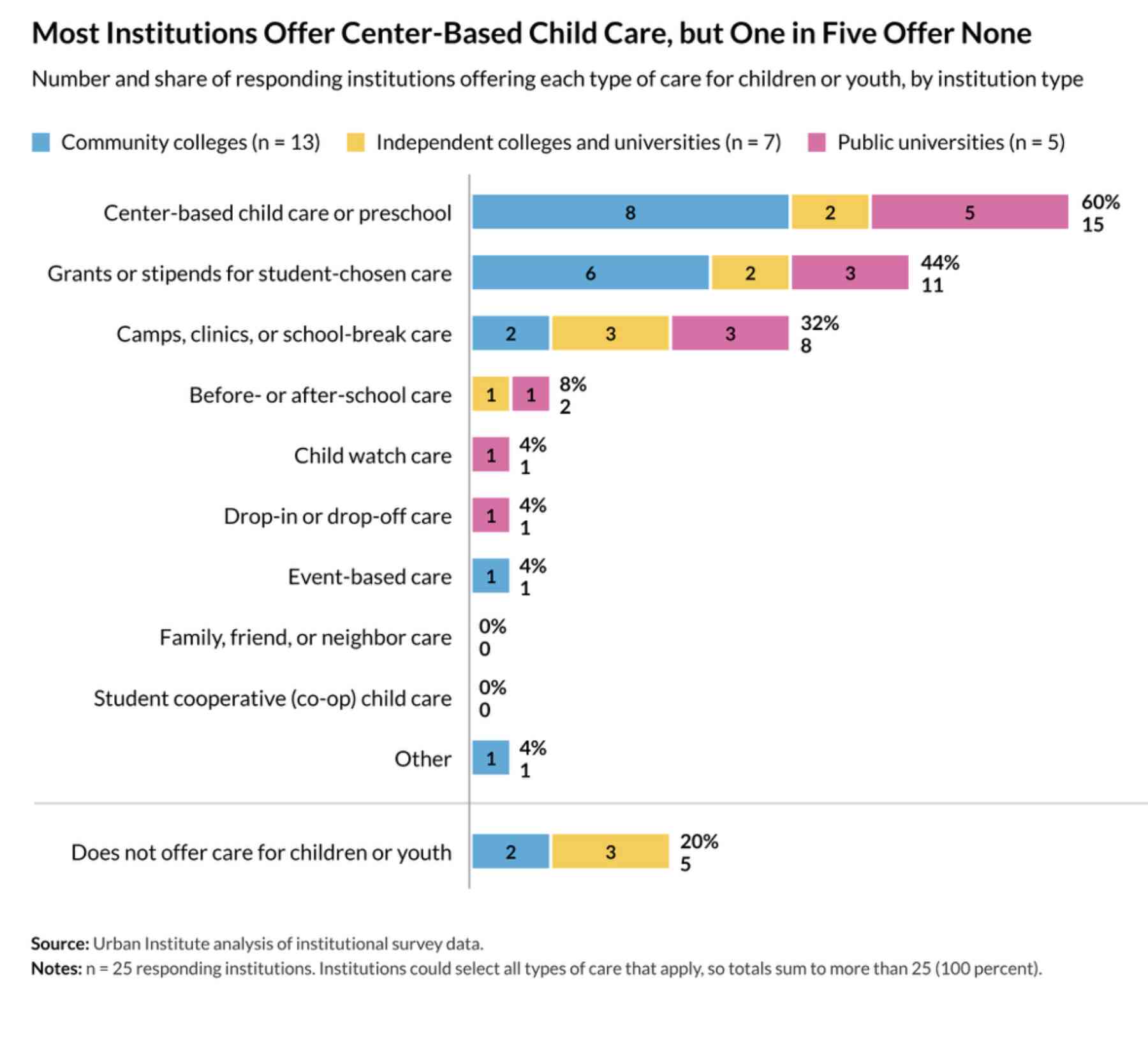
In 2026, we surveyed Oregon's public and private nonprofit colleges about their child care offerings. Of the 35 colleges invited, 25 responded (71%). Not every college answered every question, so the denominators below vary.
College Offerings
- 20 of 25 colleges (80%) reported providing some type of child care offering.
- 15 of 25 offer regular, ongoing care, and all 15 offer center-based care.
- 5 of 25 offer no care for children or youth: 2 community colleges and 3 independent colleges.
- All 5 public universities offer some care.
- Center-based care is the most common offering (15 colleges), followed by grants or stipends (11) and camps, clinics, or school-break care (8).
- Colleges with any offering provide an average of 2 types: 1.6 at community colleges, 2.0 at independent colleges, and 2.8 at public universities.
Child Care Centers
- The 15 colleges with centers reported 21 centers in total.
- 18 of 21 centers (86%) provide practicum or clinical placements for ECE students.
- 13 of 21 (62%) name supporting parenting students as a purpose.
- 5 of 21 (24%) say parenting students used half or more of their slots in the past 12 months.
- 9 of 21 (43%) offer a reduced rate specifically for parenting students.
- 17 of 21 (81%) often or always have a waitlist.
- 10 of 21 (48%) serve infants.
- 13 of 20 (65%) close by 4:30 p.m., and none are open evenings or weekends.
- 18 of 21 (86%) are licensed by the state, 11 (52%) participate in the state quality rating and improvement system, and 2 (10%) are nationally accredited.
- Tuition or private pay is the most common funding source (12 of 17 centers that reported funding, or 71%).
- 12 of 19 centers (63%) say sustaining their funding requires significant advocacy every year or that their survival is uncertain. Two (11%) describe their funding as stable.
Looking Ahead
- 4 of 23 colleges (17%) are adding or expanding care, and 13 (57%) have no plans to.
- 4 colleges (17%) describe care that closed or was cut recently.
- 7 of the 20 colleges (35%) with an ECE degree program have no campus child care center.
Strengthening Child Care Supports for Student Parents: An Inventory and Action Planning Tool for Colleges and Universities helps an individual college or university take stock of the child care options available to its parenting students and how the college helps them find and pay for care. The inventory asks about:
- Types of care available
- Priority enrollment, reduced rates, and waitlists
- Help finding and paying for care
- Funding sources used or explored
- Other child care supports for parenting students
- Campus policies on children
- Unmet needs and future plans
Colleges can use the results to document gaps in care, identify strategies to address them, and build or update web pages for parenting students. The inventory ends with a reflection and action-planning section.
Check out the tool!
Click here for the inventory and action planning tool.
How to Cite This Inventory:
Kate Westaby. 2026. Strengthening Child Care Supports for Student Parents: An Inventory and Action Planning Tool for Colleges and Universities. Urban Institute.
Acknowledgments:
This inventory is adapted from An Assessment of College Child Care and Early Childhood Education Offerings: A Tool for State Agencies, College Systems, and Regional Organizations and was developed with support from The Ford Family Foundation.
Preparing
- Name a lead to coordinate the inventory and gather input from offices that have relevant information. These offices may include student services or basic needs, financial aid, the campus child care center or early childhood education program, human resources, the college's foundation, and institutional research.
- Involve parenting students. Ideally, include them in completing the inventory. At minimum, include them in reviewing the results and setting priorities. Compensate them for their time when possible.
Completing and Using the Inventory
- Treat “Not sure” answers as findings, since they show where information is not tracked or shared across offices.
- Review the results as a team before completing the action plan, and share findings with leadership and parenting students.
- Use the results to update your parenting student web page, and revisit the inventory regularly (e.g., annually) to track progress.
This inventory has not yet been piloted. If your college uses it, we would welcome hearing about your experience at KWestaby@urban.org.
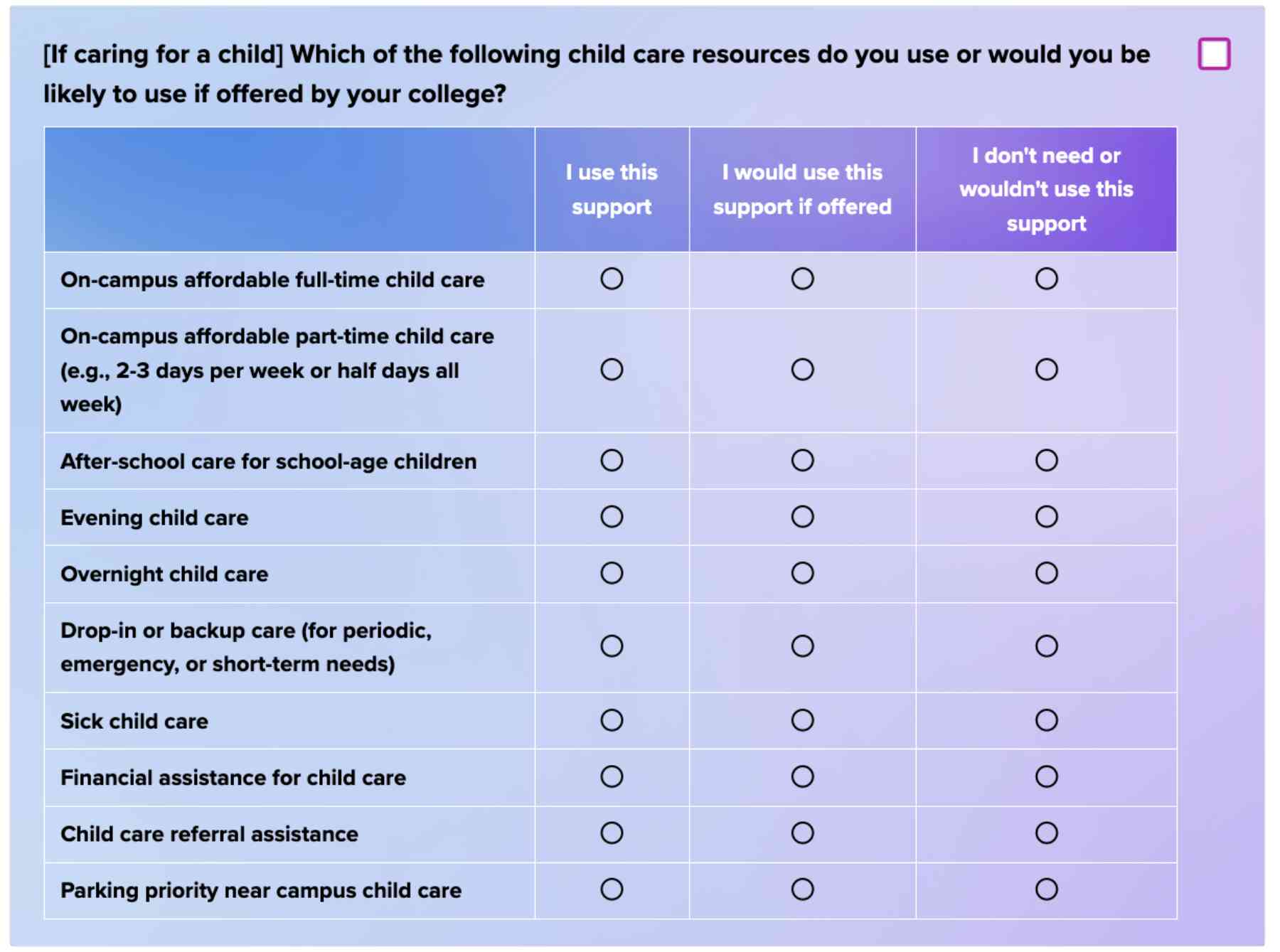
Example of a child care question for parenting students
Click here for an example from the Family-Friendly College Toolkit survey builder where college staff can select questions to develop a survey.
We recommend using the Family-Friendly College Toolkit survey builder. With this tool, you can gather feedback from parenting students about the types of child care they need to persist in and complete college.
To raise response rates, consider direct outreach.
At Tarleton State University, a graduate student assistant called enrolled parenting students to ask about their needs and awareness of college resources. Of 249 parenting students, 130 (52%) responses. Reach out to Shelly Brown (sbrown@tarleton.edu) and Allison Shoot (ashoot@tarleton.edu) for more details.
Many colleges survey parenting students, but few publish the results.
San Francisco State University's Student Parent Assessment Final Report (2025) documents time poverty, child care barriers, and the need for other basic needs supports.
No results match your filters.
Access to flexible, affordable child care can shape whether parenting students enroll in college and complete a degree. Because the models below differ in hours, ages served, cost, and scale, most colleges will need more than one to meet the range of families’ needs. The right mix depends on a college’s parenting students and the resources available on campus and in the community.
Child care or early childhood education centers are state-licensed programs, typically located on campus and operated by the college or a partner organization, that provide care mainly during standard working hours. Centers must meet zoning requirements and are inspected by state licensing, health, and fire safety officials. In Oregon, for example, centers are inspected annually by the Child Care Licensing Division, a sanitarian, and the fire marshal. Some centers occupy purpose-built facilities, while others are located in repurposed or renovated spaces. The number of children a center may serve depends on space, staffing, and other licensing factors.
Child care centers on college campuses typically serve parenting students, faculty, staff, and sometimes the broader community. Many also serve as training sites, often called lab schools, where students in early childhood education, psychology, nursing, and related programs complete observations, internships, and student-teaching hours. Smaller campuses may have only one center, while larger campuses may have several.
About 35 percent of undergraduate parenting students have a child age 0–3.
Source: Authors' analysis of the 2019–20 National Postsecondary Student Aid Study.
Advantages
- Care is reliable, with consistent staffing and substitutes, and parents can plan around a yearly calendar.
- Centers are inspected and monitored for health, safety, group size, adult-to-child ratios, and staff training.
- Programs may actively promote healthy child development and use early learning curricula.
- Staff must complete ongoing training (in Oregon, at least 15 hours annually).
- Centers can provide consistent care for infants as young as 6 weeks, which matters most where shortages are concentrated among children ages 0–3.
Disadvantages
- High operating costs and administrative demands.
- Less flexible hours; centers typically operate only during standard business hours.
- Expensive; may be out of reach for some student families without a subsidy or sliding-scale tuition.
- Care is often limited to children age 5 and younger, leaving gaps for families with school-age children who need after-school care.
- When centers also serve faculty and staff, student access may be limited, depending on how waitlists are structured. Having a center on campus does not guarantee that students are served.
Ages Served
State licensing systems define age categories, which determine staffing ratios, group sizes, and other requirements.
Infant and Toddler Care (birth through age 2)
In Oregon, 94 percent of counties are child care deserts for infants and toddlers, meaning there are more than three children for every regulated slot.
In Oregon, “infant care” refers to supervised care, guidance, and primary nurturing of children aged 6 weeks to 12 months, and “toddler care” refers to care for children 12 to 36 months old.
Preschool-Age Care
In Oregon, 25 percent of counties are child care deserts for preschool-age children.
Under Oregon rules, a preschool-age child is at least 36 months old but not yet eligible for kindergarten as of the first day of the school year. Preschool-age care is typically easier to find than infant and toddler care.
Some campus preschool programs offer valuable early learning but operate only half days, which limits their usefulness as child care. These programs may be less suitable for parenting students who seek full-time care.
Further Considerations
Colleges should determine whether to operate a campus center directly or partner with an external organization, such as a Head Start grantee, a state prekindergarten program, or another nonprofit or for-profit provider. Partnerships can expand access to affordable care and reduce administrative burden. However, partnerships may also limit the population served or create disruptions that fall hardest on parenting students, such as a partner ending its contract in the middle of an academic term.
Funding
Tuition and fees are typically the largest source of funding for child care centers. Other sources can offset these costs, including:
- The federal Child Care Access Means Parents in School (CCAMPIS) program
- Institutional support, such as in-kind space, custodial services, employee benefit packages, and financial aid
- State higher education child care funding
- Student activity fees earmarked for parenting student support
- Support from student government or faculty and student associations
- College foundation support
- Child care subsidies funded by the federal Child Care and Development Fund (CCDF)
- Temporary Assistance for Needy Families (TANF)
- U.S. Department of Agriculture (USDA) Child and Adult Care Food Program (CACFP)
- United Ways
- Foundations
- Individual and corporate contributions
- Head Start
To learn more about these funding sources, see the Funding section.
Waitlist Prioritization
Prioritizing certain groups on waitlists can help ensure that parenting students have access to care. Parenting students may experience more life and schedule instability than faculty and staff, which can limit their access to center care. Tiered waitlists can direct slots to the families with the greatest need. Groups to consider prioritizing include:
- Undergraduate students
- Students with high financial need (such as Pell Grant recipients)
- Single parents
- Students facing homelessness or basic needs insecurity
- Students in clinical programs
- Siblings of enrolled children
Portland State University's Helen Gordon Child Development Center
Serving 200 children ages 4 months to 5 years, the Helen Gordon Child Development Center has two roles: (1) providing high-quality, on-campus early education and care for the children of students, faculty, and staff, and (2) serving as an academic resource for faculty and students in early childhood education, child and family studies, psychology, and related programs. To help families offset the cost of care, the center draws on a CCAMPIS grant (covering 30–50 percent of tuition costs), a university-administered subsidy for parenting students, CCDF funds through Oregon's Employment Related Day Care (ERDC) program, Oregon's Parents as Scholars program, and Oregon's Student Child Care Grant. The center operates year-round, Monday through Thursday from 7:30 a.m. to 5:30 p.m. and Friday from 7:30 a.m. to 3:00 p.m.
Midland College's Pre-K Academy
Midland College's Pre-K Academy provides high-quality early childhood education on campus to nearly 300 children ages 3 and 4. The center is open from 7:30 a.m. to 5:30 p.m. Children receive meals, speech therapy, and nursing care as part of their enrollment. The center is funded through a combination of Head Start funds, charter funds from the local school district, private donors, and a small share of private-pay families. Midland College also runs a second on-campus center for younger children and works with a nearby community partner provider.
Colleges can offer short-term, drop-in child care to support parenting students who need flexible, part-time, or occasional care while attending classes, studying, or accessing campus resources.
Child watch typically provides brief periods of supervised care while parents remain on campus or nearby and are readily available if needed. Programs are generally designed for shorter visits, often around 1 to 2.5 hours, although actual durations vary by program. By using existing campus space and small-scale programming, child watch can provide an accessible, cost-effective starting point for colleges seeking to expand child care supports as resources and institutional capacity grow.
Drop-in or drop-off care typically accommodates longer periods of care, such as 4–5 hours or a full day. Depending on the program, parents may be able to leave the child care facility or campus while their children receive care. Services may be available on a walk-in or advance-reservation basis, accommodating both unexpected child care needs and planned academic activities.
Because it is flexible, drop-in care may be valuable for commuter students, students using campus academic supports, and parents who need shorter-term rather than full-day care. Some programs, such as child watch, offer care for as little as a single class or study session, while others can be used for a full day. Many programs use online booking and payment software. Some programs offer the service free to parenting students, drawing on Child Care Access Means Parents in School (CCAMPIS) and other grants, community partnerships, and student activity fees. To stay staffed and meet adult-to-child ratios, programs often employ Federal Work-Study students, parents, and early childhood education students, or partner with organizations such as the YMCA or Boys & Girls Clubs.
Advantages
- Meets the needs of students with short, specific commitments, such as a single class, a club or student government meeting, or a tutoring or advising session.
- Serves as a safety net for gaps in care, for example, when a student's regular child care arrangement falls through or when school-age children have a no-school day.
- Can support waitlisted families until a permanent spot opens.
- Provides as-needed care for students who prefer to care for their children at home or do not want full-time care.
- Can suit colleges with limited budgets, since short-term models may face lighter licensing requirements or qualify for exemptions, might be able to use repurposed space, and can rely on part-time staff or work-study students.
Disadvantages
- Unlikely to be a complete solution for students with heavy course loads or back-to-back classes.
- Insufficient for students in programs that require labs, clinical rotations, or shifts longer than 3–4 hours.
- Limited hours may leave parents too little time to attend class, study, and meet with faculty.
- Less suitable for families with very young children, as infants and toddlers benefit from consistent primary caregivers and routines.
- May serve as a stopgap that masks parenting students' ongoing need for full-day, full-week care.
Implementation will depend on whether a college offers child watch, in which parents remain on campus during brief visits; drop-in care, in which parents may leave for longer periods; or both. This decision affects licensing requirements, staffing, facilities, and costs.
Program Model and Phased Implementation
Assess parenting student demand to determine which model, operating hours, and eligible ages would be most useful (these programs could serve ages 0–12). Some students need care for a single class or study session, while others need longer periods of care for labs or back-to-back classes on a drop-in basis. Colleges may begin with a small-scale child watch pilot, offering limited hours during high-demand periods such as midterm and final exams or campus events. They can then expand to longer drop-in hours as demand and institutional capacity grow. Tracking participation by time of day and child age can help colleges refine services and demonstrate program value.
Another promising approach is to start with a program that has a known need for supplemental care, such as a health care training program, to build trust and refine the model. Colleges can design the approach with students, gather their feedback, and expand it once it is successful.
Licensing and Regulatory Considerations
Program requirements vary by state and care model. Factors such as duration of care, parent proximity, staffing, capacity, and ages served may determine whether a program requires a child care license or qualifies for an exemption. Child watch programs that require parents to remain on campus and reachable by phone, and that limit the length of each visit, may be more likely to qualify for an exemption than drop-in programs in which parents leave campus. For example, under Oregon’s child care licensing rule, drop-in care is defined as irregular care that does not exceed 25 hours per week (or 2.5 full days) per child. The shorter child watch and longer drop-in care durations described above are illustrative program practices, not universal regulatory limits, so colleges should confirm requirements with their state licensing agency. Colleges should also review institutional insurance policies. They may also draw on risk-management procedures from campus departments that already oversee programs involving minors, such as youth camps.
Staffing and Program Operations
Because attendance in drop-in and child watch programs can vary from day to day, staffing requires particular attention. Advance reservations, alongside a limited number of walk-in spaces, can help programs anticipate attendance, and enrollment limits for each time block can help maintain required adult-to-child ratios. Programs may need to limit eligible ages or designate separate times for infants and toddlers. Federal work-study students, early childhood education students, and on-call staff can help programs adjust staffing during peak periods, such as midterms and finals. Colleges should also develop clear policies for registration, check-in and check-out, parent availability, emergency contacts, and maximum care durations. Collecting enrollment forms and emergency contact information once per term can streamline individual visits, and tracking each child’s hours of care can help programs remain within applicable limits.
Facilities, Funding, and Partnerships
Child watch and drop-in programs do not necessarily require a dedicated child care facility. Colleges can identify accessible multipurpose spaces near classrooms, libraries, or tutoring services that offer restroom access, age-appropriate equipment, and established emergency procedures. Programs offering longer periods of care may also need space for rest and meals. Some programs are offered free to parenting students and funded through CCAMPIS grants, student activity fees, or institutional support, while others charge modest hourly or sliding-scale fees. To learn more about these funding sources, see the Funding section. Colleges can also partner with public or campus libraries to bring storytimes, crafts, and STEM activities into child watch spaces, with library staff leading activities while child watch staff provide supervision.
Oregon State University's Our Little Village
Oregon State University’s Family Resource Center operates Our Little Village (OLV) Milne and OLV Dixon, short-term reservable and drop-in child care programs for the children of students and employees, open Sunday through Friday. Care is free for students and costs $25 per child per day for employees (as of 2026). OLV Milne is in the Milne Computer Center on the Corvallis campus's main quad, and OLV Dixon is in the student recreation center. Available for children ages 5 months through 10 years, OLV allows parenting students to attend class, study, and use campus resources while their children are in a safe, developmentally appropriate setting.
West Valley College's Tiny Scholars Storytime
West Valley College's Tiny Scholars Storytime illustrates how colleges can build on library programming and early literacy partnerships to offer family-friendly activities that welcome parenting students and their children. While not a drop-off care program, this model shows how colleges could bring library storytimes and other enrichment activities into existing child watch services.
This approach covers a range of supports that let parents choose their own care, on or off campus. It may include helping parents apply for and use existing public programs or the state's child care subsidy funded by the federal Child Care and Development Fund (CCDF). Support may take the form of need-based stipends, scholarships, or grants that offset out-of-pocket child care costs. Including child care expenses in a student's financial aid cost of attendance (COA), which can make the student eligible for additional aid (mostly loans), also falls into this category, as do sliding-scale vouchers for student-chosen care.
Funding student-chosen care lets families find care that fits their cultural or linguistic preferences, parenting practices, changing schedules, and location, which matters especially in rural areas. It can help more families secure the care they need to complete their programs.
Advantages
- May support retention and completion.
- Expands access to care for low-income and nontraditional students.
- Offers flexibility for students to choose programs that fit their specific schedules (including night and weekend care), cultural preferences, or locations.
- May reduce stress, since families can choose the care that best fits their needs.
- Requires less college oversight and administration than operating care directly.
Disadvantages
- Requires significant ongoing funding, such as student activity fees, endowments, or grants.
- Liability concerns may lead colleges to restrict funds to licensed or regulated providers, excluding nannies and family, friend, or neighbor (FFN) care, which reduces flexibility for families.
- Limited funding may mean that some eligible students are turned away or receive too little support.
- Stipends paid directly to students may affect their taxes or financial aid.
- Programs funded by temporary grants or one-time gifts may be unstable for students in multiyear programs.
Eligibility and Priority
Colleges should determine who qualifies for funding and how limited funds will be prioritized. Factors to consider include:
- Demonstrated financial need
- Minimum enrollment or credit requirements
- Eligibility of undergraduate and graduate students
- Eligibility of families with a stay-at-home partner
- Priority for certain groups, such as first-generation students or single parents
Eligible Care and Disbursement
Colleges should also determine what types of care funds may cover. Allowing unlicensed care gives families the most flexibility. Restricting funds to licensed or regulated providers may address quality and liability concerns but limits families’ choices. Licensure rules can be particularly burdensome for parents who need care during evening and weekend hours.
Funds can be disbursed in several ways, each with tradeoffs. Direct-to-student stipends maximize student autonomy and choice. Reimbursement, in which students submit receipts for care already received, can burden students because they must pay costs up front. Vouchers that pay providers directly minimize student burden but increase paperwork and administrative oversight.
Financial Aid, Tax, and Legal Considerations
Colleges should ensure that child care funding does not inadvertently reduce a student’s financial aid package. They should also offer clear tax guidance if a stipend counts as taxable income for the student or the care provider. To manage liability, colleges may work with general counsel on disclaimers stating that the college provides financial assistance only and is not responsible for the quality, safety, or actions of the care provider the student chooses. For tax implications, the college might offer to connect students with free tax advisors on campus or in the community.
Data Collection
Tracking participants’ retention, GPAs, time to completion, and demographics can help colleges monitor outcomes and make the case for continued funding.
University of Oregon's Childcare Subsidy Program
Funded by the incidental fee that the University of Oregon charges all students each term, the Childcare Subsidy reimburses parenting students 40 percent of eligible monthly expenses, up to an age-based maximum, as of 2026. Students must be enrolled in at least one credit to apply. Families may use child care of their choosing as long as the provider is registered or certified by the state, or has passed a background check and been approved by program staff. The program reimburses only care needed so a parent can attend classes, study, engage in an internship, or work. Lessons or activities (e.g., soccer practice, music lessons) and summer camp may qualify if the family demonstrates that the child is participating for child care reasons.
University of Michigan's Child Care Subsidy
The University of Michigan’s Child Care Subsidy, administered through financial aid, helps students on the Ann Arbor campus who have financial need pay for state-licensed child care. To qualify, students must be enrolled at least half-time in a degree program (or an eligible nondegree program) and meet satisfactory academic progress requirements. Their children must be 12 or younger, or under 19 for children with special needs. Students with a spouse or partner qualify only if that partner is enrolled at least half-time or works at least 20 hours per week, with an exception for partners unable to work because of a disability. For 2026–27, maximum awards per term are $4,788 for one child, $7,019 for two, and $9,258 for three or more, and awards cannot exceed the actual cost of care. The subsidy is paid to the student through the university’s student account system after the provider’s license and the student’s expenses are verified. Students apply each term, and funds are awarded first come, first served until they run out.
North Carolina's Child Care Grant
Funded by the General Assembly since 1993 at about $3 million a year, North Carolina’s Child Care Grant helps parenting students at the state’s 58 community colleges pay for child care. The North Carolina Community College System administers the grant, and each college’s financial aid office runs it locally. Students generally must be state residents, complete financial aid forms, and maintain academic eligibility, though colleges set their own priorities and requirements. The grant can pay for licensed centers, unlicensed providers, nannies, relatives other than the parents, before- and after-school programs, and summer programs. Colleges may reimburse the student once care has been delivered and class attendance verified, or they may pay providers directly.
After-school programs, also called out-of-school time (OST) programs, serve school-age children and youth with academic support, mentoring, sports, and the arts. Programs range from reading- or math-focused programs to sports, arts, and STEM programs, as well as multipurpose programs such as 21st Century Community Learning Centers, Boys & Girls Clubs, and YMCAs.
In 2025, about 7 million US children attended after-school programs.
These programs are typically offered at local K–12 schools or through community organizations. Colleges can partner with these providers to connect parenting student families with existing programs or bring services directly to campus.
By extending care beyond the traditional school day, these programs can help parenting students attend classes, study, and meet other academic commitments while supporting their children's learning, development, and well-being.
About half of parenting students have only school-age children.
Parenting students who live in the surrounding community can use these programs where eligibility allows, and colleges can reserve spaces or scholarships for parenting student families, particularly in high-demand programs.
Advantages
- Fills the gap that emerges as children age out of early childhood care but still need supervision and structured activities.
- Builds on programs that already exist in most communities, so colleges can expand access without operating care themselves.
Disadvantages
- Many programs charge fees that can put them out of reach for families under financial strain, and popular programs may fill quickly.
- Programs are designed as youth enrichment rather than support for parenting students, so their hours may not cover evening classes, labs, or clinical placements.
Colleges can help parenting students use existing K–12 before- and after-school programs or, where local options do not meet students' needs, host care on campus.
Connect Families with Existing Programs
- Map local options: Identify programs at schools near campus and where parenting students live. Note hours, grade levels, fees and subsidies, enrollment deadlines, and transportation. Then check whether program hours cover evening classes and commutes. Share this information through parenting student web pages or hubs, at orientation, and as part of advising.
- Build relationships with program operators: These include district after-school or expanded learning coordinators, school principals, and community operators such as YMCAs, Boys & Girls Clubs, and parks and recreation departments. These contacts can support referrals, shared outreach, and reserved or reduced-cost spaces for parenting student families.
- Address transportation: Where dismissal times overlap with classes, coordinate pickup arrangements or extended care. In rural areas, regional partnerships across districts can help offset long travel distances and limited program availability. Check whether a school bus or shuttle can stop on campus.
Host Care on Campus
Where community programs do not meet the need, colleges can host school-age care, usually by partnering with an established after-school provider, but they can also build a new program. Campus child care centers, recreation facilities, and education departments may have space and staff to contribute. Align hours with K–12 dismissal times and class schedules, plan safe travel between schools and campus, and build on existing institutional procedures for staffing, supervision, insurance, and licensing.
Fund Access
Scholarships, subsidized enrollment, and institutional or philanthropic support can reduce costs for families. The federal Child Care Access Means Parents in School (CCAMPIS) program may also support school-age care, subject to program requirements.
Use Statewide Networks
Statewide after-school networks can connect colleges to providers, funding, and partners. In Oregon, OregonASK offers resources and professional development for after-school and expanded learning programs.
Long Beach City College's Boys & Girls Club Partnership
Long Beach City College partners with the Boys & Girls Clubs of Long Beach and Long Beach Unified School District to provide free after-school care for parenting students with children ages 5–18. Offered at two community-based locations, the program provides homework assistance, meals, and enrichment activities in STEM, arts, and athletics, along with transportation from participating local schools. The partnership shows how community colleges can use existing community resources to expand access to child care, reduce barriers for parenting students, and support their academic progress.
Cooperative (co-op) child care is a model in which families share responsibility for shaping or supporting a child care program. Parents may help in classrooms, raise funds, or serve on committees or governing boards, often working alongside professional early childhood educators.
Co-ops vary in structure: some are run by parents, while others employ professional staff and invite families to participate. Many offer reduced tuition or credits in exchange for participation, so costs and expectations vary by model.
Cooperative child care may work best where parenting students want a role in shaping their children's care and the college can provide institutional or community support. Flexible models may also appeal to families seeking lower costs or stronger connections with other parenting students.
Advantages
- Can lower costs through participation credits and shared resources.
- Gives parents a voice in their children's care and builds community among parenting student families.
- Can build on an established cooperative preschool or existing campus center rather than starting from scratch.
Disadvantages
- Participation can be hard to balance with classes, work, and caregiving, especially for students with nontraditional schedules, limited transportation, or disabilities.
- Relying on volunteer labor can make it hard to ensure quality and sustainability; essential care still requires qualified, paid staff.
- Depends on sustained parent interest, which may be hard to maintain as students graduate.
Click for Questions to Consider
Colleges can develop cooperative child care by partnering with existing programs, campus child care centers, or parenting student groups, and they can shape the model around available resources and family interests.
Start with Partners and Campus Resources
Local cooperative preschools, parent organizations, and early childhood education departments are natural partners. The college can contribute space, administrative support, or funding while an established organization runs daily operations. Locations near student housing or campus child care facilities may work well, and education departments can provide supervised student placements.
Keep Participation Optional and Care Affordable
Offer a range of ways to participate, such as classroom activities, fundraising, committees, or governance, with virtual and extended-family options. Participation credits can lower costs. Scholarships, subsidies, or institutional funding should keep care affordable for families who cannot volunteer, and credits should not replace reliable funding for professional staff.
Set Governance and Operations
Clarify how families, educators, and the college share decisions. Build on existing policies for staffing, insurance, and licensing. Parents can complement qualified staff but should not substitute for required supervision.
Parent Cooperative Preschools International offers models, training, and start-up resources.
University of Oregon's Co-op Family Center
The University of Oregon-affiliated Co-op Family Center began in 1978 as a student-family cooperative in which parents exchanged participation time for child care support. Today, the center operates as a professionally staffed early childhood program serving university-affiliated families and community members. Families can participate in classroom activities, committees, and governance, with tuition credits available for eligible participation. The center shows how a student-led cooperative can evolve into a sustainable, professionally staffed program while keeping families involved.
Camps, clinics, and school-break programs offer supervised activities and enrichment opportunities for children and youth during summer, winter, and spring breaks, holidays, and other K–12 school closures.
Programs may include full-day or half-day camps, sports clinics, STEM activities, arts, outdoor recreation, and college-readiness programming. They are often hosted by colleges, K–12 schools, parks and recreation departments, and community organizations.
Camps, clinics, and school-break programs can be most useful for parenting students whose classes, exams, clinical placements, or internships continue when K–12 schools are closed, including during summer terms. Many colleges already run youth programs that could be made more accessible to these families.
Advantages
- Fills predictable gaps in care when K–12 and college calendars do not align.
- Often builds on youth sports, recreation, STEM, and arts programs that colleges already run.
- Can serve siblings of different ages in one place.
- Gives children opportunities for recreation, learning, and early exposure to college.
Disadvantages
- Many programs are short, such as half-day clinics or weeklong camps, and offer enrichment rather than the full-day supervision families may need.
- Fees, early registration deadlines, and limited spaces can put popular programs out of reach.
- Campus youth programs are often marketed to the broader community or run as fundraisers, so parenting students may not hear about them or receive priority.
Click for Questions to Consider
Colleges can expand access by building on existing campus youth programs and community partnerships rather than creating new programs.
Open Existing Campus Programs to Parenting Students
Campus recreation centers, athletics departments, and individual teams often run youth camps and clinics, sometimes as fundraisers marketed to the broader community. Working with recreation directors, athletics administrators, and parenting student support staff, colleges can:
- Reserve spaces: Designate a portion of camp or clinic enrollment for children of parenting students, particularly in high-demand programs. Because registration often opens months ahead and popular sessions fill quickly, early outreach matters.
- Subsidize participation: Use institutional funds, scholarships, or philanthropic support to offset registration fees and related costs. Some programs may generate revenue that can reduce costs for parenting students who need it most.
- Dedicate programming: Adapt existing camps or clinics into offerings specifically designed for parenting student families, with accessible pricing, schedules, and age eligibility.
- Coordinate across campus: Engage parenting student support services, student affairs, recreation, and athletics departments to coordinate outreach, enrollment, and financial assistance.
Match Coverage to Families' Needs
Compare local K–12 calendars with the academic calendar to find gaps, and consider adding sessions during summer terms, spring break, or teacher workdays. Check whether programs offer full-day supervision or only short sessions; a two-hour clinic may provide valuable enrichment but will not cover a class or workday. Consider extended hours, sibling enrollment, accommodations for children with disabilities, and the full cost of participation, including supplies, meals, and transportation. Ask parenting students which formats and schedules would help most.
Build on Existing Safety Practices
Existing youth camps and clinics likely have safety, supervision, insurance, and emergency procedures to build on, and peer colleges can share policies and program models. Confirm that these procedures, any licensing exemptions, and insurance coverage apply to the new program.
Partner with the Community
Local schools, recreation departments, and youth organizations may offer jointly hosted camps, shared enrollment, or subsidized spaces in established programs. In rural areas, neighboring colleges or school districts can rotate camp locations or combine enrollment to make programming feasible.
LaGuardia Community College's Horizons NYC Summer Program
LaGuardia Community College's Horizons NYC Summer Program provides free summer child care and academic enrichment through the college's Early Childhood Learning Center. The seven-week program includes arts, swimming, and field trips, helping parenting students continue their coursework while their children participate in supervised activities.
University of California, Berkeley's Youth Recreation Summer Camps
UC Berkeley's Youth Recreation Summer Camps give parenting students, along with faculty and staff, early access to registration. A separate financial assistance program helps eligible families offset participation costs. The approach improves access to existing campus programs without creating new camps.
Oregon State University's KidSpirit Launch Session Camps
Oregon State University's KidSpirit Summer Day Camps include full-day (8:30 a.m. to 4:30 p.m.) single-day camps designed for parenting students attending summer Launch Sessions. Children take part in sports, arts, science, and other supervised activities while parents attend campus onboarding. Camps cost $95 per day (as of 2026). The model shows how colleges can schedule existing youth programs around parenting students' academic commitments.
Event-based child care is temporary care that a college offers during major campus events, such as sporting events, commencement ceremonies, alumni weekends, or evening lectures. Unlike drop-in care or child watch, which serve parenting students while they attend class or study, event-based care is tied to a specific event and helps parents who are students, staff, or visitors attend.
Event-based care may be most useful for parenting students who want to attend milestones and campus events but lack care for one-time or evening occasions.
Advantages
- Helps parenting students attend milestones such as commencement or orientation without having to find a babysitter.
- May increase engagement among alumni and donors with young children.
- Signals that the college is family-friendly.
Disadvantages
- Does not meet the need for routine, dependable care.
- Serving infants and toddlers requires more specialized staffing and space, so some programs limit the ages they accept.
Colleges can often build on procedures they already use for youth camps, athletics events, and other campus programs involving minors.
Risk Management and Liability
- Insurance coverage and waivers can follow the process the college uses for youth sports clinics and camps.
- Develop protocols to ensure that all staff complete background checks and that check-in and check-out procedures are secure.
- Check state licensing requirements for short-term event care. Some states exempt short-term care from licensing, while others set requirements for staff-to-child ratios, square footage, and the ages of children served.
Cost and Funding
- Care may be free to families, funded by student fees or athletics revenue, or offered as a paid add-on to event tickets. To reach parenting students, consider free or subsidized care for students and simple advance registration.
Facilities
- Choose a secure, accessible location, such as a student recreation center, an early childhood education classroom, or a multipurpose room.
Partnerships
- Partnering with a community organization, such as a local YMCA, can provide staffing and oversight. Programming can also run as an extension of an existing drop-in care program.
University of Utah's Crimson Kids Game Day Drop-In Child Care
The University of Utah's Crimson Kids Game Day Drop-In Child Care, overseen by the university's Student Parent Support Center, offers care during home football games for children ages 6 weeks to 10 years at the university's UKids center in the tailgate parking lot. Care is free for parenting students during game times, and other fans pay hourly rates (as of 2026). Families register online or at the door, and spaces are first come, first served.
Milligan University's Commencement Child Care
Milligan University offers free child care in a campus classroom during commencement and encourages parents of young children to use it.
Family, friend, or neighbor (FFN) care is child care provided by someone a family knows and trusts, such as a grandparent, relative, family friend, or neighbor. Care may take place in the child's or caregiver's home and may be paid or unpaid.
FFN care is often exempt from licensing, but requirements vary by state and caregiving arrangement. Caregivers receiving public child care subsidies may need to meet additional registration, background check, training, or health and safety requirements.
FFN care may work best for parenting students who have trusted caregivers nearby, particularly those seeking flexible, familiar, or culturally responsive care. Because not every student has such a network, FFN support works best as a complement to, not a replacement for, formal child care options.
Advantages
- Offers flexible scheduling that can cover evening classes, clinical placements, internships, and irregular work schedules.
- Provides familiar caregivers and care that reflects families' cultural and linguistic preferences.
- Builds on arrangements families already trust, with relatively modest college investment.
Disadvantages
- Unavailable to students without nearby caregiving networks, including international students and students who relocated for college.
- Arrangements can be fragile: caregivers may be unpaid, untrained, or unavailable, often without backup care.
- Paid arrangements may be hard for families to sustain without subsidies or emergency aid.
- Paying a family member or friend may change interpersonal dynamics in ways that are challenging for parents to navigate.
Click for Questions to Consider
Colleges can support FFN care by helping families pay caregivers, connecting caregivers with resources, and fostering networks among parenting students.
Help Families Access Financial Assistance
Connect parenting students with subsidies that may cover FFN caregivers, and help them navigate applications, caregiver registration, and state requirements. In some states, subsidy programs funded by the Child Care and Development Fund can pay approved FFN caregivers for eligible families.
Connect Caregivers with Resources
Partner with Child Care Resource and Referral agencies, early childhood education departments, and community organizations to offer caregivers child development resources and safety training. Colleges can also welcome caregivers to campus family events, early literacy activities, and parenting workshops, and share tools that help families and caregivers set expectations about schedules, pay, transportation, and backup care.
The Family, Friend & Neighbor Child Care Alliance connects informal caregivers with child development resources, learning opportunities, and community support.
Foster Connections among Parenting Students
Regular gatherings, family-friendly events, and peer networking can help parenting students build relationships that may lead to shared resources or informal care exchanges. Colleges can create the conditions for these networks without expecting students to provide care for one another.
For more information: New America's research on FFN care and parenting students highlights strategies colleges can use to support existing caregiving arrangements, including priority course registration and connections to community resources.
Oregon's Employment Related Day Care (ERDC)
Oregon's Employment Related Day Care program helps eligible families pay approved family, friend, or neighbor caregivers while parents work or attend school.
City of Los Angeles's Family, Friend, and Neighbor Care Guidance
The City of Los Angeles's FFN Care Resources offer practical guidance on identifying trusted caregivers, establishing care arrangements, and connecting caregivers with resources. Colleges can adapt this approach to help parenting students navigate informal care options.
No results match your filters.
Sustaining child care for parenting students depends on funding that covers programs’ costs while keeping care affordable for families. A common benchmark is that families should spend no more than 7 percent of their income on child care. The federal government originally set that figure as a guideline for copayments by low-income families receiving subsidies, not as a general affordability standard, though some programs now use it as a cap. This section describes common funding sources and how colleges can use them, often in combination, to support parenting students. Entries are grouped into federal, state, private, and Oregon-specific sources; the Oregon entries show the kinds of state and local programs colleges can look for elsewhere.
Federal Funding
The Child Care and Development Fund (CCDF) is the primary federal funding stream for child care subsidies. It is authorized under the Child Care and Development Block Grant Act and Section 418 of the Social Security Act, and it goes to states, territories, and tribes to help low-income families pay for child care. Under federal rules, families can qualify with incomes up to 85 percent of their state’s median income. Each state sets its own eligibility rules and policies and documents them in a three-year CCDF State Plan.
For parenting students, CCDF:
- Can count college coursework and job training as qualifying activities, depending on state rules
- Is typically paid directly to child care providers, which reduces families’ out-of-pocket costs
- Uses a sliding fee scale, so family copayments are based on income and family size
- Lets families choose from a range of settings, including licensed centers, family child care homes, and, depending on state rules, license-exempt family, friend, and neighbor (FFN) caregivers
Because states set their own rules, parenting students’ access varies widely. For example, some states count study time, while others require students to also work a minimum number of hours. Copayments also vary: a 2024 federal rule capping copayments at 7 percent of family income was rescinded in 2026, giving states more discretion over what families pay. Colleges can explore and compare state policies in the Urban Institute’s CCDF Policies Database.
Eligibility for parenting students depends on state rules:
- Many states count postsecondary enrollment as a qualifying activity. In states that do not, parenting students may still qualify by working the required number of hours.
- Income limits vary by state, up to the federal maximum of 85 percent of state median income. Oregon, for example, sets initial eligibility at 200 percent of the federal poverty level (FPL).
- Children must be under age 13, or, at state option, under age 19 if they have special needs or are under court supervision.
- States can prioritize particular populations when funding is limited.
After-school or before-school care
Camps, clinics, or school-break care
Center-based child care, preschool, or early childhood education center
Drop-in care or child watch, depending on state rules
Family, friend, or neighbor care, depending on state rules
Cooperative (co-op) child care, depending on state rules
Applying:
- Parenting students apply through their state's child care subsidy agency. In Oregon, the Department of Early Learning and Care (DELC) administers CCDF, primarily through the Employment Related Day Care (ERDC) program.
Using funding:
- Register campus child care centers and lab schools as approved subsidy providers so payments flow directly to them.
- In states that contract for slots, colleges with early childhood education (ECE) lab schools can hold contracts that offer subsidized care to parenting students while the center also serves as a training site.
- Offer on-campus help with state applications, income verification, and required interviews.
Innovative tips:
- Partner with state contracted-slot programs to secure subsidized infant, toddler, or preschool slots on or near campus.
- Where states allow it, help parenting students who rely on relatives or friends for early-morning, evening, or weekend care register those caregivers as license-exempt providers.
- Identify parenting students who qualify for waitlist exemptions so they can access subsidies sooner.
- When students report dependents on financial aid forms, connect them with CCDF application help and other child care resources.
- Check rules before combining funds. In Oregon, for example, students cannot receive both ERDC (Oregon's CCDF program) and the Oregon Student Child Care Grant.
Georgia's Student Parent 2Gen Pilot
Georgia's technical colleges offer on-campus help applying for the state subsidy. Through the Student Parent 2Gen Pilot, colleges partner with Georgia's early learning agency, which runs the state's CCDF subsidy program, Childcare and Parent Services (CAPS). Consultants based on campus help parenting students apply, find quality child care, and connect with other resources. In fall 2024, two-thirds of participating parenting students who applied received subsidies, compared with 22 percent of applicants statewide. By the end of 2025, 234 parenting students had received subsidies through the pilot.
San Diego Community College District's Child Development Centers
San Diego Community College District funds its child development centers through state child care contracts supported by CCDF and state dollars. District students with young children receive first priority for slots, and many families pay very little.
Understanding Your State's CCDF Rules
- Urban Institute: CCDF Policies Database. Compares state subsidy rules, including eligibility, copayments, and approved activities.
- Administration for Children and Families: FY 2025–2027 State and Territory CCDF Plans. Provides each state's current three-year plan.
- Child Care Aware of America: What’s in the FY 2025–2027 CCDF Plan. Explains in plain language what state plans cover.
CCDF and Parenting Students
- New America: What States Can Do to Help College Students Get Child Care Support. Describes state policies, including those in New York and Georgia and in states that require students to work.
- New America: Beyond Tuition, Funding for Campus-Based Child Care. Describes how campus centers combine funding sources, including CCDF.
- WorkRise (Urban Institute): Implications of Providing Child Care Assistance to Parents in Education and Training. Estimates how removing CCDF barriers for parenting students would affect participation and earnings.
- Institute for Women's Policy Research: The Family-Friendly Campus Imperative. Provides background on campus supports for community college parenting students.
Child Care Access Means Parents in School (CCAMPIS) is a competitive federal grant program authorized under the Higher Education Act. The U.S. Department of Education oversees the program, and starting with the fiscal year 2026 competition, the U.S. Department of Health and Human Services (HHS) administers it on the department's behalf. CCAMPIS is designed to support low-income parenting students, generally those eligible for Pell Grants. Institutions of higher education that awarded at least $250,000 in Federal Pell Grants in the preceding fiscal year can apply for four-year awards.
With CCAMPIS funding, colleges can:
- Offer free or reduced-cost child care using a sliding fee scale, so costs reflect what families can afford
- Provide care at campus-operated centers or through contracts with community providers
- Offer care during evening and weekend hours that fit class schedules, along with supports such as parenting workshops
Child care facilities supported by CCAMPIS must meet state or local licensing requirements, and colleges must have a plan for those facilities to become accredited within three years of the first award. There is no statutory age limit, though many colleges limit benefits to children under age 13 (or up to age 17 with documented special needs).
To qualify, parenting students generally must:
- Be eligible for a Pell Grant (undergraduates) or demonstrate low income (graduate students)
- Maintain satisfactory academic progress, as defined by their college
After-school or before-school care
Camps, clinics, or school-break care, if licensed
Center-based child care, preschool, or early childhood education center
Drop-in care or child watch, if licensing requirements are met
Grant funding or stipends for student-chosen care, if the provider is licensed and formally partnered with the college
Cooperative (co-op) child care, if licensed
CCAMPIS funding is valuable but not predictable. New competitions do not open every year, and award numbers depend on annual appropriations and on how the Department of Education structures each competition. The Department expected to make about 148 awards in the fiscal year 2026 competition, compared with 264 in fiscal year 2023, but made only 40. Colleges that rely on CCAMPIS may face gaps between grant cycles, which can make child care programs hard to sustain.
Applying:
- Colleges apply directly through Grants.gov when the competition opens, typically in summer.
Using funding:
- Offset child care tuition for low-income parenting students at campus or partner centers, often covering most of their out-of-pocket costs.
- Expand center capacity by extending hours into evenings and weekends, opening infant and toddler rooms, or hiring early childhood educators.
- Contract with licensed, accredited community providers to reserve slots for parenting students when campus facilities are full or unavailable.
- Fund related supports, such as parenting education, family workshops, developmental screenings, and peer support networks.
- Cover staff costs for a CCAMPIS coordinator or parenting student navigator, along with allowable indirect costs.
Innovative tips:
- Combine CCAMPIS with state programs, such as preschool programs or student child care grant funds. For example, CCAMPIS can cover infant and toddler care and nontraditional hours while state funds cover core preschool hours.
- Use FAFSA or state aid data to identify students who are "independents with dependents" and invite them to apply.
- Include child care expenses in parenting students' cost of attendance through the dependent care allowance, which can leave more room for CCAMPIS support.
- Use CCAMPIS to support campus centers that double as training sites for early childhood education (ECE) students, making care more affordable for parenting students while giving ECE students hands-on experience.
- Collect data on students' parenting status and child care needs to strengthen applications.
Tarleton State University's CCAMPIS Provider Network
Tarleton State University received a CCAMPIS grant in 2023. Rather than operating child care only on campus, Tarleton uses the grant to fund memoranda of understanding (MOUs) with partner providers, including providers that serve students farther from campus or near its several locations.
Portland State University's Helen Gordon Child Development Center
Portland State University's Helen Gordon Child Development Center uses a CCAMPIS grant to cover 30 to 50 percent of tuition costs for eligible parenting students and combines it with a university-administered subsidy and state funding to lower families' costs.
- U.S. Department of Education: CCAMPIS Program Page. Explains the program's purpose, eligibility, and grant competitions.
- Congressional Research Service: Child Care Access Means Parents in Schools (CCAMPIS): In Brief. Gives an overview of the technical aspects and history of the CCAMPIS program.
- Urban Institute: Using Data to Strengthen Your CCAMPIS Application. Shows how colleges can use data on parenting students to build a stronger application (webinar).
- Urban Institute: The Child Care Access Means Parents in School Program (CCAMPIS). Briefly explains the CCAMPIS program (published 2022, before recent changes).
Head Start (ages 3 to 5) and Early Head Start (pregnancy to age 3) are federally funded programs that provide free early education and comprehensive services, such as health screenings, nutrition, family support, and parent education, to income-eligible families. Head Start is one of the earliest two-generation program models, focusing on the well-being of children and their parents. Colleges can partner with an existing grantee or apply for federal funding to operate a program on or near campus.
In many partnerships, the college provides space or other in-kind support while the grantee operates the program and manages compliance.
Partnerships may include:
- A Head Start or Early Head Start classroom located on campus and operated by a community-based grantee
- Free or reduced-cost campus space provided as an in-kind contribution
- Reserved enrollment for income-eligible parenting students
- Shared family support services connecting parents to academic advising, public benefits, housing assistance, and other campus resources
- Observation, practicum, and internship opportunities for students in early childhood education, social work, and related programs
- Wraparound child care that extends Head Start into a full day or full year
Families generally qualify if their income is at or below 100 percent of the federal poverty level, or if they receive Temporary Assistance for Needy Families (TANF) or Supplemental Security Income (SSI), are experiencing homelessness, or have a child in foster care. Programs may enroll a limited share of families above these limits.
Parenting students who benefit the most:
- Income-eligible parenting students
- Parents with children ages 3 to 5 (Head Start) or from birth to 3 (Early Head Start)
- First-generation and Pell-eligible students
Parenting students who benefit the least:
- Parents with children outside Head Start age limits
- Families whose incomes exceed eligibility requirements
- Parents who need full-day or full-year care, since many programs operate part day on a school-year calendar
- Students requiring care during evenings, weekends, or extended academic schedules
After-school or before-school care
Camps, clinics, or school-break care
Center-based child care, preschool, or early childhood education center, including family child care homes (through the Head Start family child care option)
Drop-in care or child watch
Family, friend, or neighbor care
Cooperative (co-op) child care
Because Head Start is federally funded, a campus partnership can expand access to high-quality care without the college bearing the full cost of operating a center. Partnerships may be especially useful for colleges serving many low-income or first-generation parenting students. Many programs operate part day on a school-year calendar, so colleges may need to pair them with other care to fit students' schedules.
To implement a partnership, we recommend the Kids on Campus steps:
- Identify a local Head Start or Early Head Start grantee interested in a campus partnership.
- Determine space requirements, licensing needs, and facility modifications.
- Establish memoranda of understanding (MOUs) outlining responsibilities, staffing, maintenance, and data-sharing practices.
- Align Head Start operating schedules with the academic calendar.
Kids on Campus Partnership Map
Kids on Campus maintains a map of community college and Head Start partnerships, so colleges can find examples in their state.
Mt. Hood Community College's Head Start and Early Head Start
Mt. Hood Community College's Child Development and Family Support Programs operate Head Start and Early Head Start for pregnant parents and families with children from infancy through preschool in East Multnomah County, showing how a college can serve as a grantee rather than only hosting a partner's center.
- Kids on Campus: Kids on Campus User Guide. Provides steps and resources for developing community college–Head Start partnerships. Kids on Campus is a partnership of the Association of Community College Trustees and the National Head Start Association that aims to increase the number of Head Start programs on community college campuses.
- US Department of Health and Human Services: HeadStart.gov. Provides official federal information about Head Start.
The Workforce Innovation and Opportunity Act (WIOA) is the main federal law funding the public workforce system. Under Title I, the U.S. Department of Labor funds states to run adult, dislocated worker, and youth programs through local workforce development boards and American Job Centers, which are called WorkSource Oregon Centers in Oregon. These programs offer career services and pay for training, often at community colleges.
For parenting students, WIOA Title I can:
- Pay tuition and fees for approved training programs through individual training accounts
- Help pay for child care as a supportive service while a participant is in career services or training
- Provide needs-related payments that help some unemployed participants in training cover living expenses
Supportive services are a last resort: participants can receive them only when they cannot get the same help from other programs, such as Child Care and Development Fund (CCDF) child care subsidies. Local workforce boards set their own supportive services policies, including caps and which providers qualify, so what is available varies by area. Federal guidance in 2026 has also encouraged states to combine their WIOA and Perkins plans and to prepare for Workforce Pell Grants for short-term training programs.
WIOA Title I eligibility depends on the program:
- Adult program: Adults age 18 and older. When funds are limited, local areas must give priority for individualized career services and training to people receiving public assistance, other low-income individuals, and people who are basic skills deficient.
- Dislocated worker program: Workers who have been laid off or are about to be, along with displaced homemakers who have lost the income of a family member they depended on.
- Youth program: Young people ages 14 to 21 who are in school or ages 16 to 24 who are not, and who face a barrier to employment. Being pregnant or parenting counts as a barrier, and at least 75 percent of youth funds must serve young people who are not in school.
To receive child care help, parenting students generally must be enrolled in WIOA through an American Job Center, be participating in career services or training, and show that they cannot get child care help from other sources.
After-school or before-school care, if the provider meets local requirements
Camps, clinics, or school-break care, if the provider meets local requirements
Center-based child care, preschool, or early childhood education center
Drop-in care or child watch, if the provider meets local requirements
Family, friend, or neighbor care, depending on local requirements
Cooperative (co-op) child care, if licensed
Applying:
- Parenting students apply through their local American Job Center, where a case manager determines eligibility and develops a service plan.
- Colleges can apply to have their programs listed on the state's Eligible Training Provider List so WIOA can pay tuition for their students.
Using funding:
- Encourage parenting students in WIOA-funded training to ask their case managers about child care help early. Local boards often require documentation and proof that other resources were tried first, and many reimburse costs only for hours spent in training.
- Coordinate WIOA child care help with CCDF subsidies. Where local policy allows, WIOA can help cover gaps, such as hours a subsidy does not cover or the wait before a subsidy is approved.
Innovative tips:
- Host American Job Center staff on campus during orientation and registration so parenting students can enroll in WIOA and ask about supportive services in one visit.
- Refer pregnant and parenting young people who are not in school to the WIOA youth program, which can help them prepare for and enroll in college.
- As Workforce Pell Grants begin for short-term programs, work with the local workforce board so eligible parenting students in those programs can also enroll in WIOA and receive supportive services, including child care.
- Share data on parenting students' child care needs with the local workforce board, which sets supportive services caps and provider rules.
Lane Workforce Partnership's Child Care Reimbursements
Lane Workforce Partnership, the local workforce development board for Lane County, Oregon, reimburses WIOA participants enrolled in training for child care based on individual need. Participants must first show they have explored other options. Care must come from a licensed or registered provider or one operated by a school district or government agency, and reimbursement covers only the time participants spend in training or other authorized services.
- CareerOneStop: Find an American Job Center. Lists American Job Centers nationwide.
- Electronic Code of Federal Regulations: 20 CFR Part 680, Subpart G. Sets federal rules for supportive services, including child care, and needs-related payments.
- CLASP: WIOA Title I Youth. Summarizes youth program eligibility, including for young people who are pregnant or parenting.
- Oregon Higher Education Coordinating Commission: WIOA Title I. Explains how WIOA Title I works in Oregon and how to find a WorkSource Oregon Center.
- Lane Workforce Partnership: Participant Supportive Services. Shows how one local board handles child care reimbursements.
The Supplemental Nutrition Assistance Program (SNAP) is a federal program, administered by states, that provides monthly food benefits on an electronic benefit transfer card. SNAP frees up household income for other costs, but SNAP Employment and Training (SNAP E&T) offers more direct help with child care. The U.S. Department of Agriculture agency that oversees SNAP was recently renamed the Food and Nutrition Administration; many resources still use its former name, the Food and Nutrition Service.
Every state operates an E&T program, which can reimburse participants for the costs of taking part, including child care, transportation, and books. Enrolling in college through SNAP E&T also meets a federal SNAP student exemption, so E&T can help parenting students qualify for SNAP when they meet no other exemption.
Colleges can become SNAP E&T providers. Through these partnerships, colleges can:
- Help parenting students pay for child care while they attend classes or training
- Use nonfederal funds, such as state appropriations or foundation grants, to serve SNAP participants and receive 50 percent federal reimbursement for allowable costs, including child care reimbursements
- Help parenting students keep SNAP by enrolling them through SNAP E&T
To be eligible for SNAP, college students must:
- Meet income limits. The federal gross income limit is generally 130 percent of the federal poverty level. Many states raise this limit, often to 200 percent, through a policy called broad-based categorical eligibility.
- Meet at least one student exemption, if enrolled at least half-time in higher education. Exemptions most relevant to parenting students include:
- Caring for a dependent child under age 6
- Caring for a dependent child age 6 to 11 when adequate child care is not available
- Being a single parent enrolled full-time and caring for a dependent child under age 12
- Being enrolled in college through a SNAP E&T program, a Workforce Innovation and Opportunity Act (WIOA) program, or another approved state or local employment and training program. In some states, this includes certain career and technical education (CTE) programs
- Receiving Temporary Assistance for Needy Families (TANF) benefits
After-school or before-school care
Camps, clinics, or school-break care
Center-based child care, preschool, or early childhood education center
Drop-in care or child watch
Family, friend, or neighbor care
Cooperative (co-op) child care
Applying:
- Students apply for SNAP through their state’s SNAP agency. Many states offer a single online application for SNAP, TANF, child care assistance, and Medicaid, such as Oregon’s Benefits Oregon portal.
Using funding:
- Become an E&T provider. Colleges that partner with their state SNAP agency can receive 50 percent federal reimbursement for allowable costs paid with nonfederal funds, such as success coaches, navigators, and supportive services.
- Pay for child care. Colleges that are SNAP E&T providers can pay for or reimburse child care costs parenting students need in order to participate, such as child care tuition and fees, when other assistance does not cover them. Each state's SNAP E&T plan sets what is allowed.
- Screen for SNAP. Colleges can set up basic needs navigation hubs to screen parenting students for SNAP student exemptions during orientation and financial aid advising, and connect them to other supports such as child care assistance.
Innovative tips:
- Combine SNAP E&T child care supports with emergency grants, campus food pantries, and transportation passes to create comprehensive retention packages for parenting students.
- Have college-based navigators help parenting students document all out-of-pocket child care costs during SNAP intake interviews. Those costs can be deducted when benefits are calculated, which can increase a family’s monthly food benefit.
- Identify likely eligible parenting students. Use FAFSA and state financial aid data to find independent students with dependents and tell them about SNAP and SNAP E&T (called STEP in Oregon), following federal rules on using financial aid data, and offer enrollment verification letters students can submit to state SNAP agencies.
- Bring SNAP E&T to where parenting students are. Host SNAP E&T coaches or visiting SNAP agency eligibility specialists in basic needs centers or parenting student spaces so students can apply and connect to SNAP E&T in one place.
- Work with the state on which programs qualify. Ask the state SNAP agency to recognize CTE and other career-focused programs as qualifying employment and training programs, so enrollment could meet the SNAP student exemption. Students would still need to meet income and other requirements.
Oregon's SNAP Training and Employment Program (STEP)
In Oregon, SNAP E&T is called the SNAP Training and Employment Program (STEP). The Oregon Department of Human Services runs STEP through community partners, including all 17 Oregon community colleges. STEP participants receive one-on-one support and may get help with the costs of training, textbooks, transportation, child care, housing and utilities, and work clothing. STEP is open to SNAP recipients age 16 and older. Students who receive TANF cash assistance get employment services through the TANF JOBS program instead. Students can ask their local human services office for a STEP referral.
Becoming a SNAP E&T Provider
- USDA Food and Nutrition Administration: Become a SNAP E&T Provider. Explains how organizations, including colleges, can partner with their state SNAP agency.
- USDA Food and Nutrition Administration: SNAP E&T State Plans. Provides each state's current plan, including its providers and the participant supports, such as child care, it allows.
- Association of Community College Trustees: SNAP Employment and Training. Offers community college leaders overview briefs, a four-part webinar series presented by Seattle Jobs Initiative, and a cohort program for colleges becoming third-party providers.
- USDA Food and Nutrition Administration: SNAP to Skills Webinar on Community and Technical College Partnerships. Explains how the 50/50 reimbursement model works with college funds (last updated in 2019).
- USDA Food and Nutrition Administration: SNAP to Skills. Provides technical assistance for building and growing SNAP E&T programs.
Understanding Student Eligibility
- USDA Food and Nutrition Administration: SNAP Eligibility for Students. Lists the official student exemptions.
- US Government Accountability Office: Report on College Students and SNAP. Estimates, in a 2024 report, that about two-thirds of the 3.3 million potentially eligible students were not receiving benefits.
- CLASP: SNAP for College Students: An Overview. Explains student eligibility in plain language (published in 2017, before the 2025 changes to work rules).
Using Financial Aid Data for Outreach
- SPARK Collaborative: Improving Collaboration between Colleges and Public Programs. Offers practical guidance on how colleges can use information they already have on students to help connect parenting students with benefits.
- National Association of Student Financial Aid Administrators: Summary of ED’s 2022 Letter on Using FAFSA Data. Summarizes the U.S. Department of Education's guidance that colleges may use FAFSA data to tell students about benefits such as SNAP.
- Georgetown Feed: USDA–ED Partnership on Student SNAP Access. Summarizes the 2024 agreement to email potentially eligible students and pilot data sharing between colleges and SNAP agencies.
The Carl D. Perkins Career and Technical Education Act, most recently reauthorized in 2018 as the Strengthening Career and Technical Education for the 21st Century Act (Perkins V), gives states federal funding to improve career and technical education (CTE) in high schools and colleges. States pass at least 85 percent of their funds to local recipients, including community and technical colleges, which decide how to use the money based on a comprehensive local needs assessment. In Oregon, the Higher Education Coordinating Commission's Office of Community Colleges and Workforce Development oversees postsecondary Perkins funds.
Perkins matters for parenting students because single parents, including single pregnant women, are one of the special populations the law requires colleges to serve. Colleges must consider these groups in their needs assessments, and the law allows colleges to use funds to reduce or eliminate out-of-pocket expenses for special populations in CTE, including the costs of child care, transportation, and fees.
Parenting students do not apply for Perkins directly.
They can benefit if they:
- Are enrolled in a CTE program at a college that receives Perkins funds
- Belong to a special population, such as single parents (including single pregnant women), individuals from economically disadvantaged families, or out-of-workforce individuals
- Meet any requirements the college sets, such as a minimum number of credits or a minimum GPA
Parenting students in two-parent families can qualify through another special population, such as students from economically disadvantaged families.
Depending on state guidance:
After-school or before-school care
Camps, clinics, or school-break care
Center-based child care, preschool, or early childhood education center
Drop-in care or child watch
Family, friend, or neighbor care
Cooperative (co-op) child care
Applying:
- Colleges receive Perkins funds through their state's CTE agency by submitting a local application based on their comprehensive local needs assessment, which they must update at least every two years.
- Use the needs assessment to document how many CTE students are parents and what they need, including child care. Supports for parenting students are easier to fund when the assessment identifies them as a need.
Using funding:
- Help students in special populations pay for child care, transportation, and fees while they are in CTE programs, as state guidance allows. Some colleges offer reimbursement programs that students apply for each term.
- Hire staff, such as a parenting student coordinator or navigator, to connect CTE students who are parents with child care and other supports.
- Fund related supports for CTE students who are parents, such as family-friendly study spaces.
Innovative tips:
- Combine Perkins-funded staff with other child care funding. A Perkins-funded coordinator can help CTE students apply for Child Care and Development Fund subsidies, care funded by Child Care Access Means Parents in School grants, or Workforce Innovation and Opportunity Act (WIOA) supportive services.
- Use Perkins data on special populations to make the case for ongoing college funding, since federal Perkins funding for colleges may change.
- Coordinate with the local workforce board. Federal guidance in 2026 has encouraged states to combine their WIOA and Perkins plans, which can make it easier to align supports for students served by both.
Quinsigamond Community College's Parenting Student Coordinator
After its comprehensive local needs assessment found that 40 percent of its CTE students were parents, Quinsigamond Community College used Perkins funds to hire a parenting student coordinator. The coordinator's work has led to new child-friendly spaces on campus, and the college has begun developing a drop-in child care center.
Trinity Valley Community College's Perkins Student Support
Trinity Valley Community College sets aside part of its Perkins funds for CTE students in special populations, including single parents. Eligible students can apply each semester for child care reimbursement, transportation assistance, and laptop or equipment loans. Students must be enrolled in at least six credit hours in an eligible workforce program and maintain a 2.0 GPA.
- National Alliance for Partnerships in Equity: Special Populations in Perkins V. Summarizes the special populations, including single parents, and what Perkins V requires for them.
- New America: How One Community College Is Leveraging Perkins to Support Student Parents. Describes how Quinsigamond Community College used its needs assessment and Perkins funds to support parenting students.
- Legal Information Institute: 20 U.S. Code § 2355, Local Uses of Funds. Lists allowable uses of local Perkins funds, including support for special populations’ out-of-pocket costs such as child care.
- Oregon Higher Education Coordinating Commission: Career and Technical Education. Describes how Oregon administers postsecondary CTE and Perkins V.
Temporary Assistance for Needy Families (TANF) is a federal block grant, authorized under the Social Security Act, that gives states funding for cash assistance and services for low-income families with children. It is also a significant source of child care funding. States can move up to 30 percent of their TANF funds into CCDF, where the money follows CCDF rules, or spend TANF funds directly on child care, where the rules can differ. States also set their own TANF eligibility rules, benefit levels, and work requirements, so what TANF offers parenting students varies widely by state.
For parenting students, TANF can:
- Open a direct path to child care assistance:
- Federal rules require states to spend at least 70 percent of their mandatory CCDF funds on families receiving TANF, leaving TANF, or at risk of needing it.
- Many states guarantee or prioritize child care subsidies for families receiving TANF, sometimes letting them skip subsidy waitlists.
- Help pay for child care through the state's TANF employment program, which may also cover transportation, books, and other supports
- Count some college or vocational training toward work requirements, which affects whether TANF-funded child care covers class time
- Protect single parents of children under 6 from having benefits cut for missing work requirements when they cannot find needed child care
- Help pay for family, friend, or neighbor care. TANF money moved into CCDF follows CCDF rules for license-exempt caregivers; TANF money spent directly on child care may follow different rules. In California, for example, families in CalWORKs (the state's TANF program) can choose license-exempt relatives, friends, or neighbors, and caregivers other than grandparents, aunts, and uncles must pass a background check.
TANF also has limits for parenting students. Federal rules count vocational education toward work requirements for only 12 months in a person's lifetime, and other college coursework counts only in limited ways. Families also face a 60-month lifetime limit on federally funded assistance. Because TANF-funded child care is generally tied to approved activities, these limits can also cut off child care help. Some states use their own funds to support parenting students in longer degree programs.
To learn more about how CCDF subsidies work, see "Child Care and Development Fund" above.
To receive TANF, and the child care help that comes with it, parenting students generally must:
- Live in the state where they apply and care for a child under 18 (or under 19 if the child is a full-time high school student)
- Have household income and assets below limits set by their state, which are often well below the federal poverty level
- Meet citizenship or qualified immigration status requirements
- Participate in the state’s TANF work program. College coursework, vocational training, or adult education may count as approved activities, depending on state rules.
Child care paid for through TANF or CCDF typically:
- Covers children under 13 and, at state option, children under 19 who have special needs or are under court supervision
- Can be provided by licensed centers, licensed family child care homes, and, in most states, license-exempt family, friend, and neighbor caregivers who meet state requirements
After-school or before-school care
Camps, clinics, or school-break care
Center-based child care, preschool, or early childhood education center
Drop-in care or child watch, if the provider is approved for subsidy payments
Family, friend, or neighbor care, if the caregiver meets state requirements (such as a background check)
Cooperative (co-op) child care, if licensed
Applying:
- Parenting students apply for TANF through their state’s human services agency. Many states offer a single online application for TANF, the Supplemental Nutrition Assistance Program, child care assistance, and Medicaid (e.g., Benefits Oregon).
Using funding:
- Host TANF employment programs on campus. Colleges can partner with their state or local human services office to host the TANF employment program on campus, offering advising, career planning, and help connecting to child care. For example, Chemeketa Community College in Oregon hosts a TANF JOBS program offering career planning and connections to certificate, degree, and apprenticeship programs.
- Connect TANF families to child care quickly. Campus basic needs navigators can identify parenting students receiving TANF and help them apply for child care assistance, including any priority or waitlist exemption their state offers.
Innovative tips:
- Align with work requirements. Line up campus work-study jobs, apprenticeships, and career and technical education programs with TANF work requirements so parenting students' coursework and campus jobs count toward required hours and their TANF child care stays in place.
- Support family, friend, or neighbor care. Help parenting students who rely on relatives or neighbors for early morning, evening, or weekend care register those caregivers through the state’s process for license-exempt caregivers.
- Bring caseworkers to campus. Host human services eligibility staff on campus during orientation and registration to make TANF and child care enrollment easier.
- Advocate for state policy changes. Encourage the state to count college, including study time, toward TANF work requirements so parenting students can keep TANF-funded child care while in school, and to support students in longer degree programs, as Maine does through its state-funded Parents as Scholars program.
Arkansas's Career Pathways Initiative
Arkansas's Career Pathways Initiative uses federal TANF funds at all 22 of the state's community colleges to help low-income parents earn credentials. Participants receive case management, career advising, and help paying for books, child care, and transportation.
California Community Colleges' CalWORKs Programs
Every California community college runs a CalWORKs program, California's version of TANF, in partnership with county welfare departments; in 2024–25, the programs served about 25,200 parenting students. At Oxnard College, for example, CalWORKs staff provide academic counseling, child care support, and work-study jobs that count toward work requirements, and they help parenting students meet the county's welfare-to-work requirements so their benefits are not interrupted.
TANF and College
- Center on Budget and Policy Priorities: College Support Programs Tailored to TANF Parents Can Expand Employment Opportunities, Increase Earnings, and Promote Equity. Profiles state programs that pair college with child care help, including California's CalWORKs, Kentucky Ready to Work, Maine's Parents as Scholars, and Vermont's Post-Secondary Education program, and recommends counting college as a work activity.
- Congressional Research Service: TANF and Vocational Education: Policy and Practice. Explains the federal rules that limit how much college counts toward TANF work requirements.
- Urban Institute: Temporary Assistance for Needy Families. Briefly describes how parenting students can benefit from TANF.
- CLASP: Ensuring Full Credit Under TANF’s Work Participation Rate. Offers practical guidance on making sure students' coursework and work-study hours count.
Program Examples
- California Community Colleges: CalWORKs Report. Reviews campus TANF programs systemwide, including child care, work-study, and coordination with county welfare offices.
- PeerTA: Arkansas Career Pathways Initiative. Profiles a TANF-funded program at Arkansas's two-year colleges that pays for child care (published in 2010; details are dated).
The Child and Adult Care Food Program (CACFP) is a federal program authorized under the National School Lunch Act and funded by the U.S. Department of Agriculture (USDA). State agencies administer it.
CACFP reimburses child care programs for nutritious meals and snacks served to enrolled children. For colleges that operate or partner with child care centers, it lowers food costs, which can help keep care affordable for parenting students.
Through CACFP, campus child care programs can:
- Receive monthly reimbursements for breakfasts, lunches, suppers, and snacks served to enrolled children
- Receive the highest reimbursement rate for children whose families receive Supplemental Nutrition Assistance Program (SNAP) or Temporary Assistance for Needy Families (TANF) benefits or who are enrolled in Head Start, since these children automatically qualify for free meals without their families reporting income
- Serve meals that meet USDA nutrition standards, which emphasize fruits, vegetables, and whole grains and limit added sugars
Public and nonprofit child care centers, including college-operated centers and lab schools, can participate if they are licensed or approved by the state. For-profit partner centers can participate if at least 25 percent of enrolled children receive child care subsidies or qualify for free or reduced-price meals. For example, San Diego Community College District received about $87,000 in CACFP reimbursements for its child development centers in 2023–24.
Eligibility runs through the child care program. When a child care program participates, it claims meals for all enrolled children age 12 or younger (or 15 and younger for children of migrant workers). Children with disabilities qualify at any age if they are enrolled in a program where most participants are 18 or younger.
Centers are reimbursed at free, reduced-price, or paid rates based on each family’s income. Children automatically qualify for the free rate if their household receives SNAP, TANF, or the Food Distribution Program on Indian Reservations, or if they are in foster care or enrolled in Head Start. Because many parenting students have low incomes or receive these benefits, collecting families' eligibility forms can increase a center's reimbursement.
After-school or before-school care
Camps, clinics, or school-break care (summer programs use the USDA Summer Food Service Program instead)
Center-based child care, preschool, or early childhood education center
Drop-in care, but not child watch
Family, friend, or neighbor care
Cooperative (co-op) child care, if licensed
Applying:
- Colleges apply through the state agency that runs CACFP, usually the state’s education, health, or agriculture department.
- Applicants need proof of licensing or approval, a nonprofit food service, and a way to track enrollment, income eligibility forms, menus, and daily meal counts.
Using funding:
- A college that runs its own child care center or lab school can apply as an independent center. A college that runs several sites can apply as a sponsoring organization.
- CACFP reimbursements must be spent on the center's food program, but they cover costs the center would otherwise pay, freeing other operating dollars to help keep fees low for parenting students.
- Centers can support their sustainability by asking families to fill out an income eligibility form. Parenting students who receive SNAP or TANF can list their case number instead of reporting income.
Innovative tips:
- Campus centers can structure CACFP dinner schedules so children receive a hot, nutritious meal while parenting students attend evening lectures or clinical rotations.
- Colleges can act as CACFP sponsoring organizations for local home-based child care providers that offer flexible drop-in care to parenting students.
Oregon Colleges' and Universities' CACFP Participation
As of December 2023, seven Oregon colleges and universities participated in CACFP: Lane Community College, Mt. Hood Community College, Portland Community College, Oregon State University, Portland State University, Eastern Oregon University, and Western Oregon University.
Texas A&M University's Children's Centers
Student workers at the Texas A&M Children's Centers help plan and prepare meals that meet CACFP rules and children's dietary needs and keep CACFP meal count records, gaining hands-on early childhood training alongside internships and practicums.
- USDA Food and Nutrition Administration: Child and Adult Care Food Program. Explains program rules, eligibility, and how to participate.
- USDA Food and Nutrition Administration: Nutrition Standards for CACFP Meals and Snacks. Describes the meal patterns participating programs must follow.
- National CACFP Association. Offers training, menus, and a directory of sponsoring organizations.
State and Local Resources
Child Care Resource and Referral (CCR&R) agencies operate in nearly every state. They help families find child care, usually free of charge, and build the supply and quality of care by recruiting, training, and supporting providers. Many are funded through state Child Care and Development Fund dollars, and many belong to the national Child Care Aware of America network.
In Oregon, the Department of Early Learning and Care (DELC) funds a network of regional CCR&Rs serving all 36 counties. They provide required health, safety, and licensing training for providers and help families find care.
CCR&R referral services are free and open to all families, with no income or enrollment requirements.
In Oregon, parenting students can:
- Search for care through the Find Child Care Oregon portal or by calling 211, with help available in multiple languages
- Narrow searches to providers that offer evening or weekend hours
- Use Oregon CCR&R Inclusive Partners resources for help finding providers prepared to serve children with disabilities or complex health needs
After-school or before-school care
Camps, clinics, or school-break care
Center-based child care, preschool, or early childhood education center
Drop-in care or child watch
Family, friend, or neighbor care
Student cooperative (co-op) child care
Partnering:
- Colleges do not need funding to refer students to their regional CCR&R; they can set up formal referral pathways so advisors, financial aid staff, and basic needs centers connect parenting students to care searches and subsidy help.
- In Oregon, DELC contracts with regional host organizations, such as education service districts, community action agencies, and community colleges, through multiyear agreements. Colleges can compete to host a regional CCR&R.
Innovative tips:
- Invite CCR&R staff to campus during orientation or at family resource centers.
Mt. Hood Community College's Child Care Resource and Referral
Mt. Hood Community College hosts the Child Care Resource and Referral of Multnomah County, which helps families find care and enrolls eligible families in Baby Promise.
Southwestern Oregon Community College's Care Connections & Education
Southwestern Oregon Community College hosts Care Connections & Education, the CCR&R serving Coos and Curry Counties.
- Oregon DELC: Child Care Resource and Referral. Describes Oregon's regional CCR&R network and how families can find their local agency.
- Child Care Aware of America. Represents the national network of CCR&Rs and offers state-by-state search tools.
Cities, counties, and special districts across the country have created dedicated local funds for child care and early learning, often through voter-approved ballot measures. Because the revenue is set aside for children and families, these funds can be more stable than support that depends on annual budget decisions. The Children's Funding Project's Funding Our Future describes seven types of state and local taxes that communities have used to support early care and education:
- Corporate and business taxes, such as San Francisco’s tax on commercial rents
- Estate and inheritance taxes
- Personal income taxes, such as Multnomah County’s Preschool for All tax on high earners
- Property taxes, such as the Portland Children’s Levy and Kalamazoo County’s child care millage
- Sales taxes, such as the Denver Preschool Program
- Sin taxes, such as taxes on tobacco, alcohol, or sugary drinks
- Special district taxes, such as Florida’s local children’s services councils
Because these funds are created locally, what they pay for, who qualifies, and how providers apply vary widely from place to place.
Eligibility depends on the local program, not on student status. Parenting students generally qualify the same way as other families. Common eligibility factors include:
- Where the family lives: Most programs serve residents of the city or county that collects the tax.
- The child’s age: Many funds focus on young children, often preschool for 3- and 4-year-olds or care for children ages 5 and under.
- Family income: Some programs set income limits, and others prioritize lower-income families.
Some programs are universal or are working toward it. For example, Multnomah County’s Preschool for All offers free preschool to 3- and 4-year-olds who live in the county and aims for universal access by 2030.
Depending on the local program:
After-school or before-school care
Camps, clinics, or school-break care
Center-based child care, preschool, or early childhood education center
Drop-in care or child watch, rarely and only if licensed
Family, friend, or neighbor care, though few programs fund it
Student cooperative (co-op) child care, if licensed
Applying:
- Become a provider. Campus child care centers and lab schools can apply to join local programs and receive per-child payments, start-up funds, and other support.
Partnering:
- Connect parenting students to local programs. List local programs on parenting student webpages and in advising, and help families apply.
- Strengthen the early childhood workforce. Many local funds invest in growing the early childhood workforce. Colleges with early childhood education programs can partner on training, credentials, and placements.
Innovative tips:
- Join local planning. Colleges can serve on advisory committees or coalitions that design and renew local funds, so that parenting students’ needs, such as evening care, are considered.
- Extend the day with other funds. Locally funded preschool slots often cover only part of the day. Pair them with Child Care Access Means Parents in School grants, state subsidies, or college funds to cover the hours parenting students need for class, work, and study.
Portland Children’s Levy
This City of Portland property tax funds early childhood, after-school, mentoring, foster care, child abuse prevention and intervention, and hunger relief programs. In May 2023, voters renewed it with 71 percent support. The renewal runs from 2024 to 2029 at about $0.40 per $1,000 of assessed property value and is projected to raise about $133 million.
Multnomah County’s Preschool for All
Voters in Multnomah County, Oregon, approved Preschool for All in November 2020. It is funded by a personal income tax on high earners: 1.5 percent on income over $125,000 for individuals ($200,000 for joint filers), plus another 1.5 percent on income over $250,000 ($400,000 for joint filers).
Kalamazoo County’s Grow Kalamazoo Millage
In August 2026, voters in Kalamazoo County, Michigan, approved a 0.5-mill property tax, about $50 a year for a home with a $100,000 taxable value, to expand child care for children ages 5 and under from 2027 through 2034. It is expected to raise about $6.4 million in its first year to lower costs for families, raise pay for child care workers, and fund grants to local providers. The county will award funds through requests for proposals developed with community input, so colleges in the county with campus child care or early childhood education programs can watch for those opportunities.
Kent County’s Ready by Five Early Childhood Millage
Voters in Kent County, Michigan, first approved this 0.25-mill property tax in 2018 and renewed it in August 2024, 59 percent to 41 percent, for six more years. It raised about $8 million in 2024 and supports about 30 community programs for children from pregnancy through kindergarten entry, such as home visiting, developmental screenings, playgroups, and help navigating early childhood services. It does not directly fund child care slots, showing that local early childhood funds can support families in ways beyond paying for care.
- Children’s Funding Project. Offers tools and technical assistance for creating and using local and state funding for children.
- Children’s Funding Project: Funding Our Future: Generating State and Local Tax Revenue for Quality Early Care and Education. Describes each tax type, with examples and trade-offs.
- Grow Kalamazoo: Frequently Asked Questions. Shows how one county explained a new child care millage to voters.
Private Funding
Some employers, including colleges and universities, offer child care support to employees as part of their benefits package. This support takes many forms, including:
- Offering on-site child care
- Partnering with local child care providers to offer subsidized tuition, tuition discounts, or priority slots
- Reimbursing employees for child care expenses
- Providing backup care
- Offering pretax dependent care flexible spending accounts (FSAs)
Colleges and universities are employers too. When student employees can use these benefits, they become another source of child care support for parenting students. Parenting students who work off campus may also be able to use their employers' child care benefits.
Parenting students may qualify for child care benefits through their employers, including colleges that employ students, if they work enough hours to be eligible for benefits. On campus, this approach is likely to benefit graduate parenting students, such as graduate assistants, more than undergraduate parenting students.
After-school or before-school care
Camps, clinics, or school-break care
Center-based child care, preschool, or early childhood education center
Drop-in care or child watch
Family, friend, or neighbor care
Cooperative (co-op) child care
Offering child care support can be a strategic investment for employers, including colleges. It helps retain employees who are parents and keeps child care disruptions from affecting day-to-day operations.
Tax incentives:
- Colleges weighing child care support as employers should consider available tax incentives. Many are nonrefundable tax credits, which help only employers that owe taxes. Public and nonprofit colleges generally do not owe federal income tax, so these credits mainly help for-profit colleges and private employers, including those that partner with colleges on child care.
- The federal Employer-Provided Child Care Credit (Section 45F) helps businesses pay for child care for employees, including building or operating a child care facility or contracting with licensed providers. Few businesses claimed the credit in the past. Starting in 2026, the One Big Beautiful Bill Act raised it to 40 percent of qualified child care costs, up to $500,000 a year (50 percent and up to $600,000 for small businesses), from 25 percent and $150,000, and broadened the costs that qualify.
- Employers can also offer dependent care FSAs, which let employees set aside pretax income for child care. Starting in 2026, the annual limit rose from $5,000 to $7,500 per household. Any employer, including public and nonprofit colleges, can offer these accounts.
- Oregon has offered businesses tax credits for helping employees pay for dependent care and for building or improving child care facilities. Like the federal credit, these help only employers that owe state taxes, so check current availability with the Oregon Department of Revenue.
Designing benefits for student employees:
- Check how many hours employees must work to qualify for benefits and whether student workers can realistically meet that threshold.
- Design benefits with student employees in mind. For example, make sure they fit parenting students’ schedules and copay budgets and that partner facilities are accessible by public transit.
- Extend employee partnerships with local providers, such as priority slots or tuition discounts, to graduate assistants and other student employees.
- Encourage parenting students who work off campus to ask whether their employers offer child care benefits, such as dependent care FSAs or backup care.
University of Oregon’s Graduate Employee Caregiving Support
The University of Oregon’s contract with its graduate employee union includes caregiving support. Graduate employees can get help with child care costs after qualifying events through the Graduate Student Assistance Fund, receive the same Care.com membership as other university employees, and use the university’s care provider network.
Oregon Employers’ Child Care Programs
Employers across Oregon support child care in different ways. Douglas County Government opened an on-site child care center for employees in 2023, Boardman Foods helped establish a child care center in Northeast Oregon, and Siemens supported on-site child care at its Wilsonville campus for more than 30 years before closing the center in summer 2026.
- Child Care Works for Oregon: Oregon Employer’s Child Care Toolkit. Helps employers think through their child care options.
- NeighborImpact and Early Learning Hub of Central Oregon: Leading With Care: Supporting Child Care as an Employer Toolkit. Walks employers through approaches to supporting employees’ child care needs.
- Bipartisan Policy Center: 45F Employer-Provided Child Care Tax Credit: 2026 Guide. Explains the expanded federal credit and which employers can claim it.
Philanthropic funding can fill gaps that public funding leaves, though it may be time-limited and more modest in scale. Types of foundations include college foundations, corporate foundations, community foundations, women's foundations, and family foundations. Individual and corporate donors can also be substantial sources of funding to help support child care for parenting students, build or improve facilities, and help develop the early childhood workforce.
Eligibility depends on the funder and the program. Because philanthropic funds are usually more flexible than public funding, colleges and funders can often decide who qualifies, including students whom public programs exclude, such as part-time students, students in noncredit certificate programs, or students who do not qualify for public aid because of their immigration status.
After-school or before-school care
Camps, clinics, or school-break care
Center-based child care, preschool, or early childhood education center
Drop-in care or child watch
Family, friend, or neighbor care
Cooperative (co-op) child care
Applying:
- Colleges can apply for foundation grants, raise donations through their own college foundations, and help parenting students apply for scholarships, such as the Ford Opportunity Scholarship.
- Many foundations fund specific priorities, so align proposals with each foundation's goals and build ongoing relationships with program staff rather than treating requests as one-time transactions.
Using funding:
- Fill gaps in public funding. For example, state aid may exclude parenting students who are enrolled part-time or in noncredit certificate programs, or may not cover building new child care facilities.
- Provide emergency child care help quickly, since private funds can usually be disbursed faster than public aid.
- Support students who do not qualify for public aid because of residency or immigration status, where the funder's terms allow.
- Support early childhood education programs and practicums that build the local child care workforce.
Innovative tips:
- Build relationships with donors. Show them what you want to build and its potential impact. Also get to know them and help them develop trust in your program and college leaders. Your college's development or advancement office may have insights into local donors.
- Combine philanthropic funds with public sources. Klamath Community College's new child care center, described below, pairs foundation gifts with state facility grants.
- Partner strategically with others who might be better positioned to receive funds. Sometimes funders have restrictions on types of grantees or total awards to one entity.
- Use data to show the need and the impact. Understanding the characteristics of parenting students and their child care needs, and then demonstrating the impact of care, can help make the case for funding.
- Use foundation funds to pilot new approaches, such as drop-in care or child care grants for part-time students, and collect data to make the case for ongoing public or college funding.
- Think about the "next ask" as you approach the end of a grant period.
The Ford Family Foundation’s Ford Opportunity Scholarship
The Ford Family Foundation, which focuses on rural Oregon and Siskiyou County, California, offers three student scholarships: Ford Scholars, Ford Transfer, and Ford Opportunity. The Ford Opportunity Scholarship may be awarded to parents of any age and to adult learners over 25. The foundation awards up to 90 renewable Opportunity scholarships a year, worth up to $40,000 a year based on financial need, to students pursuing an associate or bachelor’s degree full time.
Oregon Community Foundation’s Betty Gray Endowment
Oregon Community Foundation manages many private donor funds. Its Betty Gray Endowment, administered by Portland State University’s Oregon Center for Career Development in Childhood Care and Education, helps early childhood professionals in Oregon pay for training and education. Applicants must work with children, or supervise staff who do, at least 20 hours a week in a licensed or approved program.
Klamath Community College’s Childcare Learning Center
Klamath Community College is building a Childcare Learning Center with the Oregon Child Development Coalition and Klamath County that will also train the college’s early childhood education students. Philanthropy is part of the funding mix: Seeding Justice awarded $500,000 to the Oregon Child Development Coalition from the state-funded Oregon Child Care Capacity Building Fund, which Seeding Justice administers, and Oregon Community Foundation and individual donors also contributed. The college’s foundation is raising $1 million from the community, alongside $2 million from Oregon’s Child Care Infrastructure Fund and $4 million from the Higher Education Coordinating Commission.
- The Ford Family Foundation: Ford Opportunity Scholarship. Describes eligibility, award amounts, and how to apply.
- Oregon Community Foundation: Grants and Scholarships. Lists current grant and scholarship opportunities.
- Portland State University: Scholarships. Describes the Betty Gray Endowment and other scholarships for early childhood professionals, including eligibility and how to apply.
- Seeding Justice: Oregon Child Care Capacity Building Fund. Describes the state-funded fund and the child care providers it supports.
- Klamath Community College Foundation: Childcare Learning Center. Describes the project, its partners, and its funding sources.
These resources are Oregon-specific, but other states have similar local opportunities.
Oregon-Specific Funding
Employment Related Day Care (ERDC) is Oregon's main child care subsidy program, funded largely through the federal Child Care and Development Fund (CCDF) and administered by the Department of Early Learning and Care (DELC). The state pays a share of the cost directly to the provider the family chooses, and family copayments cannot exceed 7 percent of monthly income. Families can use ERDC with licensed centers, family child care homes, and approved, license-exempt family, friend, or neighbor caregivers.
To qualify, parenting students generally must:
- Be attending school; students can qualify without working (in two-parent families, both parents must be working or in school)
- Have household income at or below 200 percent of the federal poverty level (FPL) to enter; once enrolled, families remain eligible up to 250 percent of FPL or 85 percent of state median income, whichever is higher
- Join the statewide waitlist, unless they qualify for an exemption, such as receiving Temporary Assistance for Needy Families or Temporary Assistance for Domestic Violence Survivors, having a child welfare referral, or having a contracted slot, such as through Baby Promise
After-school or before-school care
Camps, clinics, or school-break care
Center-based child care, preschool, or early childhood education center
Drop-in care or child watch
Family, friend, or neighbor care
Cooperative (co-op) child care
Applying:
- Families apply through the Oregon Department of Human Services (ODHS), which processes applications for DELC, online through ONE Oregon or Benefits.Oregon.gov, by phone at 1-800-699-9075, or at a local ODHS office. Because of high demand, ERDC has used a waitlist since November 2023.
Using funding:
- Colleges do not apply for ERDC; the subsidy belongs to the family. Colleges can help parenting students apply and can register campus centers as approved ERDC providers, which brings steady subsidy revenue.
Innovative tips:
- Use FAFSA and Oregon Student Aid Application (ORSAA) data to identify low-income students with children and help them join the waitlist or apply.
- Help students decide whether ERDC or the Oregon Student Child Care Grant better fits their situation, since they cannot receive both.
Oregon State University's Family Resource Center
Oregon State University's Family Resource Center explains ERDC to parenting students, including that students no longer need to work to qualify, and links them to the state application. It also points students to the university's own need-based child care assistance, funded by student fees, and to a cost-of-attendance revision for child care costs.
- Oregon DELC: Employment Related Day Care. Describes eligibility, copayments, the waitlist, and how to apply.
The Oregon Student Child Care Grant is a state financial aid grant administered by the Office of Student Access and Completion (OSAC) under the Higher Education Coordinating Commission. It helps undergraduate parenting students with financial need pay for child care so they can stay enrolled and complete their programs. Awards cover the lesser of actual child care costs or the average local cost of care, up to $10,000 per academic year. Students choose their own provider, but they cannot receive the grant and Employment Related Day Care (ERDC) at the same time.
To qualify, parenting students must:
- Be Oregon residents
- Be enrolled or planning to enroll as undergraduates at an eligible Oregon college or university, without a prior bachelor's degree
- Enroll full time, or half time with enough credits to earn 36 credit hours a year (24 at semester schools); full-time students receive priority
- Maintain satisfactory academic progress and not be in default on federal student loans
- Have a child age 12 or younger, or older with documented special needs
After-school or before-school care
Camps, clinics, or school-break care
Center-based child care, preschool, or early childhood education center
Drop-in care or child watch
Family, friend, or neighbor care
Cooperative (co-op) child care
Providers must be registered or certified with the state or listed with the Oregon Department of Human Services.
Applying:
- Students submit the FAFSA (or the ORSAA, Oregon's alternative for students who cannot file the FAFSA) and the Oregon Student Child Care Grant application in the OSAC Student Portal.
Using funding:
- Because funding is limited, OSAC gives priority to prior recipients who remain eligible, then ranks new applicants by credits earned, financial need, use of eligible providers, and enrollment level.
- Funds are paid to the college's financial aid office and applied to the student's account; students then pay their provider.
Innovative tips:
- Flag grant recipients in billing systems so pending state disbursements do not trigger drops for nonpayment.
- Include child care expenses in recipients' cost of attendance, which may open eligibility for additional aid.
- Offer short-term, low- or no-interest emergency loans to cover child care deposits or fees before grant funds post.
- Keep campus child care centers registered or certified with the state so grant recipients can use their awards there.
Portland State University's Helen Gordon Child Development Center
Parenting students at Portland State University can use Oregon Student Child Care Grant awards at the Helen Gordon Child Development Center, which also accepts ERDC and combines federal Child Care Access Means Parents in School grant funds and university subsidies to reduce families' costs.
- Oregon Student Aid: Oregon Student Child Care Grant. Describes eligibility, award amounts, and how to apply.
The Child Care Infrastructure Fund (CCIF) is a $50 million Oregon grant program, created by House Bill 3005 (2023) and funded through lottery bonds, that pays to build, renovate, or expand child care facilities. Business Oregon administers it in partnership with the Department of Early Learning and Care (DELC), with an emphasis on rural and underserved areas. Unlike subsidies, which help families pay for care, CCIF pays for buildings and facility improvements.
Parenting students do not apply for CCIF; they benefit when they use a facility the fund built or expanded. The fund prioritizes facilities serving families in state-supported programs, such as Employment Related Day Care (ERDC), Preschool Promise, Head Start and Oregon Prenatal to Kindergarten, and culturally specific programs.
After-school or before-school care, in licensed facilities
Camps, clinics, or school-break care
Center-based child care, preschool, or early childhood education center
Drop-in care or child watch, if licensed
Family, friend, or neighbor care
Cooperative (co-op) child care, if licensed
Applying:
- Colleges and universities can apply directly as primary applicants through the Business Oregon application portal during open funding rounds.
Using funding:
- Grants pay for capital costs, such as construction, renovation, property acquisition, and safety upgrades, not ongoing operations.
Innovative tips:
- Pair a CCIF-funded facility with operating funds, such as Preschool Promise or Baby Promise slots, Child Care Access Means Parents in School grants, or ERDC payments, so the new space is sustainable.
- Design space for a lab school staffed in part by early childhood education student teachers, so it serves both parenting students and the college's early childhood education program.
- Consider siting care in or near student family housing or basic needs centers to shorten parents' commutes.
- Consider facilities designed for drop-in, evening, or weekend care, which few community providers offer.
Klamath Community College's Childcare Learning Center
Klamath Community College received a $2 million CCIF grant to help build a new on-campus Childcare Learning Center.
- Oregon DELC: Oregon Child Care Infrastructure Fund. Describes the fund's goals and priorities.
- Business Oregon: Child Care Infrastructure Fund. Provides application information and funding rounds.
Preschool Promise (PSP) is a state-funded Oregon program, administered by the Department of Early Learning and Care (DELC), that provides free preschool for 3- and 4-year-olds from families with low incomes. Rather than giving families vouchers, the state funds slots directly with providers through a mixed-delivery model that includes licensed centers, home-based child care, and schools. Programs must operate at least six hours a day, four days a week, and 900 hours a year.
Grantees receive an annual rate per slot to cover teachers, supplies, and program costs, plus one-time start-up funds and a transportation enhancement for programs that transport children.
To qualify, families must:
- Have a child who is 3 or 4 years old by September 1 of the school year
- Have household income at or below 200 percent of the federal poverty level; children in foster care or experiencing homelessness qualify regardless of income and receive priority
- Apply through their regional Early Learning Hub, which determines eligibility
After-school or before-school care
Camps, clinics, or school-break care
Center-based child care, preschool, or early childhood education center, including home-based child care programs that hold Preschool Promise slots
Drop-in care or child watch
Family, friend, or neighbor care
Cooperative (co-op) child care
Applying:
- Providers apply through DELC's Request for Applications cycle. Before applying, they must register in the state's Electronic Grant Monitoring System and obtain a state vendor ID.
- Approved applicants not funded in a round may be placed in the PSP applicant pool, which DELC draws from as funding or slots become available.
Using funding:
- The state funds slots, not general operations; a campus center might receive 10, 15, or 20 slots.
Innovative tips:
- Use PSP slots to offer free preschool to parenting students' children on campus, and work with the regional Early Learning Hub to help eligible parenting students apply.
- Pair PSP slots with Child Care Access Means Parents in School grants or other funds to extend care beyond the PSP day to match class schedules.
- Operate PSP classrooms as lab schools, and consider dual-credit partnerships so high school students in early childhood pathways can complete practicum hours there.
We have not yet identified a college example of this approach.
- Oregon DELC: Preschool Promise. Describes eligibility, how families apply, and funding opportunities for providers.
Baby Promise is a free Oregon early care and education program for infants and toddlers ages 6 weeks to 3 years from families with low incomes. Funded through the federal Child Care and Development Fund (CCDF) and administered by the Department of Early Learning and Care (DELC), it contracts directly with child care providers for slots, much like Preschool Promise. Families pay no copays or program fees, and the program provides diapers, wipes, and formula at no cost.
Baby Promise currently operates in Multnomah, Crook, Jefferson, Deschutes, Coos, and Curry Counties and the Reedsport area.
To qualify, parenting students must:
- Have a child between 6 weeks and 3 years old
- Meet Employment Related Day Care (ERDC) eligibility, including income limits
- Live in a region where Baby Promise operates
Families in Baby Promise contracted slots can bypass the ERDC waitlist.
After-school or before-school care
Camps, clinics, or school-break care
Center-based child care, preschool, or early childhood education center, including home-based family child care
Drop-in care or child watch
Family, friend, or neighbor care
Cooperative (co-op) child care
Applying:
- Families enroll through the Child Care Resource and Referral (CCR&R) program in their region, such as NeighborImpact in Central Oregon or the CCR&R of Multnomah County, which confirms eligibility and arranges placement.
- Providers can contact DELC about becoming Baby Promise sites.
Using funding:
- Contracted slots give campus centers stable revenue for infant and toddler care, the most expensive care to staff.
Innovative tips:
- Colleges that host a regional CCR&R can connect eligible parenting students directly to Baby Promise enrollment.
- Pair Baby Promise slots with other funds, such as Child Care Access Means Parents in School grants, to cover hours beyond the contracted day.
Mt. Hood and Southwestern Oregon Community Colleges' Regional CCR&Rs
Mt. Hood Community College and Southwestern Oregon Community College host the regional CCR&Rs that enroll families in Baby Promise in Multnomah County and on the southern Oregon coast.
- Oregon DELC: Baby Promise. Describes eligibility, service areas, and how families enroll.
Oregon Prenatal to Kindergarten (OPK) is Oregon's state-funded program modeled on Head Start and Early Head Start. Administered by the Department of Early Learning and Care (DELC), it serves families with low incomes from pregnancy through age 5, following the federal Head Start Program Performance Standards. Programs offer free early education along with health, nutrition, and family support services, through center-based and home-based options.
A pregnant parenting student, or a parenting student with a child under age 5, can qualify if the family:
- Has income at or below 100 percent of the federal poverty level (FPL), or
- Receives public assistance such as Supplemental Nutrition Assistance Program, Temporary Assistance for Needy Families, or Supplemental Security Income benefits, is experiencing homelessness, or has a child in foster care, regardless of income
Families that spend more than 30 percent of income on housing can deduct those costs when income is calculated, which can help parenting students with high rents qualify. Programs may also enroll a small share of families above these limits, and at least 10 percent of enrolled children must be children with disabilities.
After-school or before-school care
Camps, clinics, or school-break care
Center-based child care, preschool, or early childhood education center
Drop-in care or child watch
Family, friend, or neighbor care
Cooperative (co-op) child care
Applying:
- Organizations apply to DELC through competitive grant cycles. About 30 grantees provide OPK services statewide.
Using funding:
- Grantees must deliver comprehensive services under Head Start standards, including education, nutrition, oral and mental health, and family wellness.
- Colleges can host an OPK classroom operated by a grantee, following the same steps as a Head Start partnership: find an interested grantee, settle space and licensing needs, put responsibilities in a memorandum of understanding, and align the program's schedule with the academic calendar. To learn more, see "Head Start and Early Head Start" in this section.
Innovative tips:
- Set up referral pathways from campus food pantries, health clinics, and family housing to local OPK programs so eligible parenting students can enroll.
- Use OPK's prenatal services to support expectant parenting students, then help families transition to infant and toddler care.
- Coordinate with nearby Preschool Promise providers on outreach and professional development.
We have not yet identified a college example of this approach.
- Oregon DELC: Oregon Prenatal to Kindergarten. Describes eligibility, services, and how families find a program.
The Portland Children's Levy (PCL) is a City of Portland fund, supported by a voter-approved property tax, that generates about $20 million a year for programs that prepare children for school, support academic success, and reduce racial and ethnic disparities. Voters first approved the levy in 2002 and have renewed it four times; current funding runs through June 2029.
PCL funds six areas: early childhood, after-school, mentoring, foster care, child abuse prevention and intervention, and hunger relief. Each five-year levy has one competitive round for large grants (three-year grants that began July 1, 2025) and a separate round for small grants (the current round funds grants starting July 1, 2026).
Parenting students do not apply to PCL directly. Their children can take part in PCL-funded programs if they live in or attend school in the City of Portland. Funded programs prioritize children and families who face disparities, including families with low incomes, families of color, immigrant and refugee families, children with disabilities, and LGBTQ2SIA+ youth.
After-school or before-school care
Camps, clinics, or school-break care
Center-based child care, preschool, or early childhood education center
Drop-in care or child watch
Family, friend, or neighbor care
Cooperative (co-op) child care
Applying:
- Nonprofits, local education agencies, community colleges, and universities can apply through WebGrants, the City of Portland's online grant system.
- Large grants require a minimum level of annual revenue in the applicant's last closed fiscal year; smaller organizations can apply for small grants.
Using funding:
- Colleges can use early childhood or after-school grants to run programs on or near campus, such as after-school tutoring or early learning programs, for Portland children, including the children of parenting students.
Innovative tips:
- Act as lead applicant or fiscal sponsor for smaller community partners that do not meet the large-grant revenue threshold, handling compliance while partners deliver services.
- Use hunger relief funding to expand campus family food pantries for parenting students whose children live in Portland.
Portland Community College's Sylvania Child Development Center
In 2009, Portland Community College's Child Development Center at its Sylvania Campus received a three-year, $467,942 grant from the Children's Investment Fund, the fund the levy created. The grant paid for evening, Saturday, and summer child care, free parenting classes, and larger subsidies, with slots reserved for low-income Portland families based on Pell Grant eligibility.
- Portland Children's Levy: What We Do. Describes the levy's funding areas, grant rounds, and oversight.
- Portland Children's Levy: WebGrants User Registration Guide. Explains how to register to apply for grants.
Child Care for Construction (CCC) is an Oregon child care subsidy for construction apprentices and recent journeyworkers. It was created through House Bill 4098 (2024), which established the Oregon CHIPS Child Care Fund with $7.5 million, including $5 million from the Oregon CHIPS Act, to support workers in the semiconductor supply chain and the construction trades. Business Oregon and the Bureau of Labor and Industries (BOLI) run the program, which builds on BOLI's Apprenticeship-Related Child Care program.
CCC keeps a family's out-of-pocket child care costs at or below 7 percent of household income, contributing up to $2,500 per child per month, and has no maximum household income. Payments go directly to the child care provider. HB 4098 also directs funds to the Child Care Infrastructure Fund for facilities in regions with CHIPS Act investments. The program is scheduled to end June 30, 2027, unless the Legislature extends it.
To qualify, parents must:
- Be registered apprentices in good standing in an Oregon construction trade, or journeyworkers who completed a registered construction apprenticeship within the past five years and continue working in Oregon (pre-apprentices are not eligible)
- Have children living at home who are under age 12, or under 17 with documented special needs, and who need care from someone other than a parent
After-school or before-school care
Camps, clinics, or school-break care
Center-based child care, preschool, or early childhood education center
Drop-in care or child watch
Family, friend, or neighbor care, if the caregiver is approved through Oregon's Department of Early Learning and Care
Cooperative (co-op) child care
Applying:
- Apprentices apply through BOLI's Apprenticeship Division (see BOLI's Financial Assistance for Registered Apprentices page), not through standard social services offices. BOLI's contracted administrator helps with applications, including in Spanish.
Using funding:
- Colleges that host registered apprenticeship programs or related training can make sure apprentices know about CCC and help them apply.
- Licensed campus child care centers can serve CCC families, and colleges can help apprentices register trusted relatives or neighbors as approved caregivers.
Innovative tips:
- Include the CCC application in onboarding materials for construction apprenticeship programs so eligible parents can enroll before training begins.
- Because construction shifts often start early or require travel, help apprentices use approved family, friend, or neighbor caregivers for early-morning and overnight hours.
We have not yet identified a college example of this approach.
- BOLI: Financial Assistance for Oregon Registered Apprentices. Explains Child Care for Construction eligibility and how to apply.
The Early Childhood Equity Fund (ECEF), created by Oregon's 2019 Student Success Act, provides about $10 million a year in grants through the Department of Early Learning and Care (DELC). It funds culturally specific organizations, defined as organizations that serve a particular cultural community and are primarily staffed and led by members of that community. Funded services include parenting education, parent-child interaction, kindergarten transition, early and family literacy, and Native language preservation.
ECEF does not set eligibility requirements for individual families. Funded organizations focus on children and families who face historical and current inequities due to factors such as race, income, zip code, or language. Parenting students can take part in ECEF-funded programs offered by culturally specific organizations in their communities.
After-school or before-school care
Camps, clinics, or school-break care
Center-based child care, preschool, or early childhood education center
Drop-in care or child watch
Family, friend, or neighbor care
Cooperative (co-op) child care
Applying:
- Organizations apply to DELC during Request for Applications windows, submitting proposals through the state's Electronic Grant Monitoring System.
- Because the fund supports culturally specific organizations, colleges are unlikely to qualify as lead applicants; they are more likely to partner with grantees.
Using funding:
- Grants are competitive and typically follow the state's two-year budget cycle. Organizations may receive grants to deliver services or to build organizational capacity before launching a full program.
Innovative tips:
- Partner with ECEF grantees to offer culturally specific parent-child groups, dual-language story hours, or child watch on campus while parenting students attend evening classes.
- Work with Tribal Nations and culturally specific organizations to co-design early childhood pathways, including Native language programs, that serve parenting students.
- Offer evening, weekend, or online early childhood education certificates to build bilingual workforce pipelines with community partners.
We have not yet identified a college example of this approach.
- Oregon DELC: Early Childhood Equity Fund. Describes the fund and current funding opportunities.
No results match your filters.
Colleges and universities may formally partner with child care providers in a variety of ways to expand access for parenting students. Partnership models can include providing child care scholarships or stipends that offset the cost of care and allow families to select an off-campus provider that best meets their needs. Eligible providers may include licensed child care centers, family child care homes, in-home caregivers, nannies, or other approved care arrangements. Colleges can also help families find care through navigation and referral services and work with partners to build local child care capacity.
Colleges may also establish formal agreements with specific providers, such as community child care centers, nonprofit organizations, family child care networks, or school-based programs, to reserve enrollment slots for students’ children. Partnerships can be designed to address common barriers parenting students face by offering flexible scheduling, evening and weekend care, transportation assistance, or multiple locations that increase accessibility for families. Because parenting students often have diverse and nontraditional schedules, partnerships can create a broader range of child care options than a single campus-based program.
Partnerships with community organizations, child care providers, and local, state, and federal programs can benefit both colleges and parenting students. Partnerships let colleges build on existing resources and expertise rather than creating every child care service themselves. They can also increase the number and variety of care options available to students while reducing what colleges spend to develop and operate programs.
Click for Questions to Consider
For parenting students, access to multiple child care options is particularly important. Parenting students often balance coursework, employment, caregiving responsibilities, transportation limitations, and changing schedules. A network of child care partners can increase the likelihood that families will find arrangements that align with their specific needs related to location, cost, operating hours, and quality.
Partnerships may also:
- Expand child care capacity without requiring colleges to build or operate facilities
- Increase access to care during nontraditional hours such as evenings, weekends, and academic breaks
- Connect parenting students with additional family support services
- Improve student retention, persistence, and degree completion
- Strengthen relationships between colleges and their surrounding communities
Types of Partnerships
Colleges and universities may collaborate with external organizations, funding sources, or child care providers to reduce child care costs for parenting students. Rather than operating child care directly, colleges use partnerships to provide financial assistance that families can use with approved community-based providers.
These partnerships may expand the number of families served, increase flexibility in provider choice, and connect parenting students with existing child care resources in the community.
Funding for these partnerships often comes from the following sources:
- Child Care Access Means Parents in School (CCAMPIS) grants: Colleges that awarded at least $250,000 in Pell Grants in the prior year can compete for four-year federal awards to help low-income parenting students, generally those eligible for Pell Grants, pay for child care. Funds can support free or sliding-fee care at campus or community providers. Care must meet state or local licensing requirements, and colleges must have a plan for those facilities to become accredited within three years of the first award.
- Foundations and donors: College foundations, community foundations, or individual donors can create child care assistance funds that parenting students use with community providers.
- Employers: Local employers that hire many students can work with the college to create a shared child care fund or voucher program used with participating providers.
- Student emergency aid: Emergency aid programs can cover short-term care when a family's usual arrangement falls through or an unexpected expense threatens enrollment.
To learn more about each source, see the Funding section.
Partnership structure: Funder (such as CCAMPIS, a foundation, or an employer) → College → Child care provider(s) the family chooses → Parenting students
Advantages
- Lets families choose care that fits their schedules, locations, and cultural or language preferences, including evening and weekend care.
- Expands access to care for low-income and nontraditional students without the college operating a program.
- Lets colleges draw on outside funding, such as CCAMPIS grants, foundation gifts, or employer contributions, rather than relying only on college funds.
- May support retention and completion.
Disadvantages
- Requires steady funding; programs that depend on time-limited grants or one-time gifts may be unstable for students in multiyear programs.
- Limited funding may mean some eligible students are turned away or receive too little to cover the cost of care.
- Does not add child care slots, so families may still struggle to find openings where care is scarce.
- Combining funding sources adds administrative work, since each funder may have its own eligibility, spending, and reporting rules.
- Stipends paid directly to students may affect their financial aid or taxes.
- Define eligibility and priority, such as whether funding is based on financial need, whether students must take a minimum number of credits, whether graduate students qualify, and whether certain groups, such as single parents, receive priority.
- Decide what counts as eligible care. Allowing unlicensed care, such as family, friend, or neighbor care, gives families the most flexibility. If liability is a concern, colleges can limit funds to licensed or regulated providers or work with general counsel on disclaimers.
- Choose how to disburse funds. Direct-to-student stipends maximize choice, reimbursement requires students to pay costs up front, and vouchers paid to providers reduce the burden on students but add paperwork.
- Agree with participating providers on how and when they will be paid, especially if the college pays providers directly.
- Tell students which providers are eligible and how to find them.
- Make sure the funds do not reduce students' financial aid, and offer clear tax guidance if a stipend counts as taxable income.
- Track each funding source's eligibility, spending, and reporting rules, especially when combining sources such as CCAMPIS and foundation funds.
- Track participants' retention, GPAs, and time to completion to monitor outcomes and make the case for continued funding.
To learn more about designing these programs, see "Grant funding, stipends, or scholarships for student-chosen care" in the Care Options section.
Bunker Hill Community College's CCAMPIS Program and Child Care Scholarships
Bunker Hill Community College in Boston uses CCAMPIS funds to lower child care costs on a sliding fee scale, giving priority to Pell-eligible single parents taking at least six credits, and offers $1,000-per-semester child care scholarships to parents of children under age 6. Its child care resource page points students to community resources, including Child Care Choices of Boston, a program of Action for Boston Community Development (ABCD), and lists Single Stop as a referral partner.
Reserved enrollment slot partnerships are formal agreements between a college and one or more child care providers that guarantee a designated number of child care openings for students' children. Rather than competing with the broader community for limited availability, parenting students gain priority access to child care spaces.
Reserved slots may be located in child care centers, family child care homes, preschool programs, or school-age care programs. Partnerships may include full-time, part-time, drop-in, infant and toddler, or school-age care options.
In a related model, colleges establish agreements with a network of community child care providers and give families vouchers that can be used only within that network. This model combines financial assistance with quality assurance and referral support.
Partnership structure: College → Partner provider(s) or provider network → Parenting students
Advantages
- Increases access in communities with long waitlists.
- Provides greater certainty for parenting students planning enrollment and coursework.
- Reduces delays associated with finding care.
- Lets colleges use existing community infrastructure.
- Can be implemented more quickly than developing a campus-based center.
Disadvantages
- Providers may charge colleges to reserve spaces regardless of utilization.
- Families have fewer choices of location and schedule than with scholarships or stipends they can use with any eligible provider.
- Agreements should clearly define eligibility criteria and referral processes.
- Reserved spaces should reflect local parenting student demand.
- Colleges may need partnerships with multiple providers to accommodate different ages and schedules.
- Put the number of slots, age groups, hours, rates, and referral steps in a written agreement (see "Memoranda of understanding and formal agreements" below).
Tarleton State University's Provider Network
In 2023, Tarleton State University received a Child Care Access Means Parents in School (CCAMPIS) grant. Rather than relying only on on-campus child care, the university established memoranda of understanding (MOUs) with multiple child care providers, creating a network that can serve students across different areas and campus locations.
North Shore Community College's YMCA Partnership
In 2021, North Shore Community College in Massachusetts began a pilot with the Demakes Family YMCA in which the college funds slots so students receive up to two hours a day of free drop-in child care, along with free study space, while they study or complete online coursework.
Colleges partner with local Head Start or Early Head Start programs to connect eligible parenting students with federally funded early childhood services. These partnerships can help families access free early education and care while colleges assist with outreach, referrals, and enrollment support. Some colleges also host a Head Start or Early Head Start program on campus.
Head Start serves children ages 3 to 5, and Early Head Start serves families from pregnancy until a child turns 3. Families generally qualify if their income is at or below the federal poverty level, or if they receive Temporary Assistance for Needy Families (TANF) or Supplemental Security Income (SSI), are experiencing homelessness, or have a child in foster care.
Partnership structure: Head Start or Early Head Start grantee → College → Early learning program → Parenting students
This model can build on existing college–Head Start relationships and links child care with broader family support services.
Advantages
- Gives eligible families free early education and comprehensive services, such as health screenings, nutrition, and family support.
- Expands access without the college bearing the full cost of operating a program.
Disadvantages
- Eligibility is limited mainly to families with low incomes and children from birth to age 5, so many parenting students will not qualify.
- Many programs operate part day on a school-year calendar, which may not cover class, work, or study schedules.
- Contact the local Head Start or Early Head Start grantee to learn about eligibility, openings, and enrollment timelines.
- Agree on how the college will refer students, and get student consent before sharing information.
- If the program will operate on campus, settle space, licensing, facility changes, staffing, maintenance, and data sharing in a memorandum of understanding.
- Where possible, align program schedules with the academic calendar or arrange wraparound care to extend the day.
- Use the Kids on Campus User Guide, from the Association of Community College Trustees and the National Head Start Association, for step-by-step guidance on community college–Head Start partnerships.
To learn more about Head Start eligibility and funding, see "Head Start and Early Head Start" in the Funding section.
Kids on Campus Partnership Map
Kids on Campus maintains a map of community college and Head Start partnerships, so colleges can find examples in their state.
Child care navigation and referral partnerships connect parenting students with organizations that specialize in helping families identify, evaluate, and access child care. Rather than operating child care directly, colleges partner with community organizations, referral agencies, nonprofit organizations, and child care experts that understand the local early care and education landscape.
Through these partnerships, parenting students may receive assistance locating available providers, understanding program quality and licensing, navigating subsidy eligibility requirements, completing applications, joining waitlists, and selecting care arrangements that meet their family's needs.
Colleges collaborate with state child care assistance programs to help eligible parenting students access subsidies. Colleges may provide application assistance, referrals, or supplemental funding to fill gaps not covered by state programs.
Navigation and referral partnerships can be particularly valuable in communities where child care options are limited, difficult to identify, or supported through multiple funding and eligibility systems.
Partnership structure: Navigation partner (such as a child care resource and referral agency, the state child care agency, or a nonprofit) → College → Parenting students
Advantages
- Usually costs less than funding or operating care, since partners bring existing provider information and expertise.
- Helps parenting students use subsidies and other benefits they may not know they qualify for.
- Can connect students with evening, weekend, or off-campus care that the college does not offer.
Disadvantages
- Does not add child care slots or lower costs on its own, so students may still face waitlists or high prices.
- Depends on partners' capacity, which varies by community.
- Identify the local child care resource and referral agency and the state agency that runs child care subsidies, and learn their eligibility rules and application steps.
- Agree on how students will be referred and how the college will follow up, and get student consent before sharing information.
- Consider placing navigators on campus or holding regular office hours there, as in Georgia's Student Parent 2Gen Pilot.
- Train advisors, financial aid staff, and basic needs staff to recognize when a student needs child care help and where to refer them.
- Track referrals and outcomes, such as subsidy approvals and enrollment in care, to see whether the partnership is working.
To learn more about state child care subsidies, see "Child Care and Development Fund" in the Funding section.
Georgia's Student Parent 2Gen Pilot
Through Georgia's Student Parent 2Gen Pilot, technical colleges partner with the state's early learning agency to place consultants on campus who help parenting students apply for the state child care subsidy, find quality care, and connect with other resources. In fall 2024, two-thirds of participating parenting students who applied received subsidies, compared with 22 percent of applicants statewide.
Child Care Resource and Referral (CCR&R) agencies are community-based organizations that help families locate and evaluate child care while supporting child care providers and communities. CCR&Rs operate in nearly every state, often with support from Child Care and Development Fund (CCDF) dollars, and play a central role in helping families access child care services and resources.
CCR&Rs typically:
- Maintain databases of licensed child care providers
- Provide referrals based on family needs and preferences
- Help families navigate child care subsidy programs
- Offer information about provider licensing and quality ratings
- Support child care providers through training and technical assistance
- Collect data regarding local child care supply and demand
- Serve as community experts on early care and education systems
Partnership structure: CCR&R → College → Parenting students
CCR&Rs can help colleges:
- Better understand local child care capacity
- Identify gaps in child care availability for parenting students
- Connect students to subsidy programs and financial assistance
- Develop partnerships with community providers
- Reduce the administrative burden of maintaining provider databases and referral systems
Referrals alone do not add child care slots, so in areas with little supply, colleges may need to pair a CCR&R partnership with reserved slots or capacity-building.
- Find the local CCR&R through the state child care agency or Child Care Aware of America.
- Ask the CCR&R for local data on child care supply, cost, and gaps to inform the college's planning.
- Agree on how students will be referred, and ask whether CCR&R staff can hold office hours or workshops on campus.
- Make sure the CCR&R knows about the college's own child care programs so it can include them in referrals.
To learn more about CCR&Rs, including Oregon's network, see "Child Care Resource and Referral Agencies" in the Funding section.
Linn-Benton Community College's Child Care Resource and Referral
Linn-Benton Community College operates Family Connections, the child care resource and referral agency for Linn, Benton, and Lincoln Counties, through its Family Resource and Education Center. Family Connections provides training, technical assistance, and business support to child care providers and maintains the provider information families use to find care. It also helps families find child care and connects them with parenting education and other community resources.
Capacity-building partnerships focus on increasing the overall supply, quality, accessibility, or sustainability of child care in a community. Unlike scholarship and stipend partnerships, which primarily reduce costs for families, capacity-building partnerships seek to expand the availability of child care services themselves.
These partnerships are particularly valuable in communities facing child care shortages, long waitlists, limited infant and toddler care, or a lack of care during evenings and weekends.
Capacity-building efforts may involve colleges, child care providers, local governments, philanthropic organizations, employers, workforce development agencies, and early childhood organizations.
Partnership structure: College and community partners (such as funders, local governments, and providers) → New or expanded child care → Parenting students and other families
Advantages
- Adds child care that serves both parenting students and the wider community.
- Draws on funding and expertise from several partners, such as state infrastructure grants, local governments, and employers.
- Can create practicum and job opportunities for students in early childhood education programs.
Disadvantages
- Takes significant time and up-front funding, especially for building or renovating facilities.
- New slots still need ongoing operating funds and qualified staff, which can be hard to find.
- Use local data on child care supply and demand, such as from the local child care resource and referral agency, to target the ages, hours, and locations with the biggest gaps.
- Look for state and local funding for child care facilities and start-up costs. For example, Oregon's $50 million Child Care Infrastructure Fund, administered by Business Oregon with the Department of Early Learning and Care, pays to build, renovate, or expand child care facilities, with an emphasis on rural and underserved areas.
- Consider ways to grow the child care workforce, such as early childhood education training or support for family child care providers.
- Agree on each partner's role in funding, building, operating, and sustaining the new care.
To learn more about the Child Care Infrastructure Fund, see the Funding section.
Klamath Community College's Childcare Learning Center
Klamath Community College received a $2 million grant from Oregon's Child Care Infrastructure Fund to help build a new on-campus Childcare Learning Center in Klamath Falls, adding child care capacity in its community.
Building a Partnership
Developing effective partnerships begins with understanding the child care landscape within the college's community. Colleges and universities should identify existing resources, assess unmet needs among parenting students, and explore opportunities for collaboration.
Colleges should:
- Understand federal, state, and local funding that supports child care access, such as Child Care Access Means Parents in School (CCAMPIS) grants and Child Care and Development Fund (CCDF) subsidies (see the Funding section)
- Conduct needs assessments or surveys of parenting students to identify gaps in care, desired locations, preferred hours, and affordability concerns (see the Assessing Needs section)
- Develop relationships with local child care providers and early childhood organizations
- Engage local Child Care Resource and Referral (CCR&R) agencies, which can provide information about provider availability, licensing status, and community needs
- Explore partnerships with community organizations such as YMCAs, Boys & Girls Clubs, Head Start and Early Head Start programs, and state-funded preschool programs
- Consider partnerships with family child care networks and culturally responsive providers that reflect the needs of diverse student populations
- Establish processes for ongoing communication, evaluation, and quality improvement with partner organizations
Formal partnerships often begin with a memorandum of understanding (MOU), contract, or service agreement that outlines the responsibilities and expectations of each partner.
Common elements of partnership agreements include:
- Purpose and Goals
- Description of the partnership's objectives
- Target population to be served (e.g., parenting students and their children)
- Roles and Responsibilities
- Services provided by the child care partner
- Responsibilities of the college or university
- Designated points of contact for each organization
- Enrollment and Access
- Number of reserved child care slots, if applicable
- Eligibility requirements
- Referral and enrollment procedures
- Age groups served
- Hours of operation
- Funding and Financial Arrangements
- Tuition assistance, vouchers, or subsidies
- Rates for reserved slots, including whether the college pays for slots that go unused
- Payment structures and reimbursement procedures
- Documentation and reporting requirements
- Data Sharing and Confidentiality
- Procedures for protecting student and family information
- Compliance with relevant privacy laws, such as the Family Educational Rights and Privacy Act (FERPA) for student records
- Evaluation and Accountability
- Performance measures and outcomes
- Reporting schedules
- Procedures for reviewing and renewing the agreement
- Duration and Termination
- Agreement timelines
- Renewal processes
- Conditions under which the partnership may be modified or terminated
No single funding source is usually enough to meet parenting students' child care needs, so many colleges combine public and private funding streams to expand access and improve sustainability (see the Funding section).
Braided funding refers to coordinating multiple funding sources while tracking each source separately and adhering to its individual requirements.
Blended funding refers to combining funding sources into a single pool that supports a common program or service.
By combining resources, colleges can:
- Serve more parenting student families than a single funding source would allow
- Reduce child care costs for students with varying income levels
- Create multiple pathways to care when families are not eligible for one specific program
- Expand child care options across multiple providers and locations
- Improve long-term sustainability by reducing reliance on a single grant or funding stream
Common funding partners may include:
- Federal programs, such as Child Care Access Means Parents in School (CCAMPIS)
- State child care subsidy programs
- Head Start and Early Head Start programs
- Institutional student-support funds
- College and university foundations
- Private philanthropic organizations
- Community organizations and local governments
- Employer-sponsored child care initiatives
As an example, a community college might use CCAMPIS funds to support Pell-eligible parenting students, state child care subsidies to cover additional low-income families, and foundation funding to assist students who fall outside eligibility requirements. Together, these funding sources create a more comprehensive child care support system than any one source could provide alone.
No results match your filters.
As we developed this guide, we spoke with national and Oregon-specific experts and identified several recurring themes, described below. For each theme, we explain why it matters and offer strategies colleges can consider.
Child care is not often understood as a fundamental support for college students. Colleges may need to explain why it matters, particularly when child care is in short supply and public child care funding is under scrutiny. The strategies below offer ways to frame the importance of child care for college leaders and other decision-makers.
- Parenting students make up a large share of the college population. Nearly 1 in 5 undergraduates overall and 1 in 4 community college students have dependent children. Supporting parenting students pays off. To raise enrollment and completion, colleges need to serve parenting students well, and child care is one of the most important supports they can offer.
- Campus child care for parenting students supports a college’s educational mission. Centers can serve as training sites where early childhood education and human development students complete the clock or practicum hours that open doors to careers in the field. In our conversations with college child care experts, we heard that college leaders valued child care that aligned with the college’s educational mission, so designing child care offerings around early childhood education or family studies program goals is a promising practice.
- Parenting students who use campus child care are more likely to stay enrolled from one year to the next. At Monroe Community College in New York, 71 percent of parenting students who used campus child care returned the following fall, compared with 42 percent of those who did not. This 29-percentage-point difference comes from an institutional comparison rather than a randomized evaluation, so it shows an association, not a proven effect. Still, it suggests that reliable child care can help parenting students stay on track.
- Parenting students who use campus child care are more likely to graduate or transfer to a four-year college. In the same comparison, 28 percent of campus child care users graduated or transferred on time, compared with 8 percent of nonusers. This measure combines graduation and transfer, so it is not a graduation rate on its own, and the gap does not prove that campus child care caused the difference. Even so, a difference this large points to campus child care as a promising support for completion.
- Child care can help parenting students attend class and can draw them to a college. In a study of a community college program that scheduled child care around students’ classes, nearly 90 percent of surveyed parents rated the program as very important to their ability to attend class. About three-quarters said its availability was part of why they chose the college. These findings reflect students’ own reports, not measured effects on attendance. Still, they suggest that well-designed child care can support both attendance and recruitment. Capacity matters, though: 26 percent of respondents had to change their class schedule at least once because a child care slot was not available.
- Child care can give parenting students more time to study and earn credits. Research using university records and survey data found that parents of preschool-aged children had less time, and less usable time, for college than comparable students with older children or no children, mainly because of child care. Students with less time were less likely to stay enrolled and earned fewer credits, even after accounting for other factors. The study did not directly measure the effect of a campus child care center. But it identifies a clear way that child care can help parenting students make progress toward a degree.
Child care licensing requirements vary considerably by state and may present challenges for colleges and universities seeking to establish on-campus child care programs. State licensing agencies regulate nearly every aspect of program operations, including staff-to-child ratios, staff qualifications and training, health and safety standards, facility requirements, emergency preparedness, nutrition, and routine inspections. All states require comprehensive background checks for employees and adherence to child abuse reporting and other health and safety procedures.
Oregon, for example, has some of the nation’s strictest licensing standards, comparable to those in states such as New York, Washington, and California. Oregon requires low staff-to-child ratios in child care centers: 1:4 for infants, 1:5 for toddlers, and 1:10 for preschool-age children. These standards promote child safety and quality care, but the staffing they require drives up operating costs.
- Learn from campus departments that already manage similar risks. Many campuses already run programs with similar regulatory and risk-management needs, such as dining services, youth athletic camps, summer enrichment programs, high school dual-enrollment activities, and community events involving minors. Working with departments that already have protocols for liability, insurance, participant safety, and regulatory compliance can reduce administrative burden and streamline implementation.
- Adapt existing policies for child care. Many colleges already run revenue-generating sports camps and workshops for community children that require liability policies and waivers. These policies could be adapted for drop-in, before- or after-school, or event-based care for parenting students.
- Partner with campus dining for meals. Campus food services likely already meet food safety requirements and operate under state health department licenses. Instead of preparing food themselves, child care programs could set up a service agreement with campus dining to deliver compliant meals or snacks.
- Review insurance early. Work with the college’s risk management office and insurer to determine whether existing policies cover child care operations or need to be expanded.
- Check whether licensing exemptions apply. In some states, short-term care, such as drop-in care while parents remain on site, may be exempt from some licensing requirements. Confirm with the state licensing agency before launching a program.
Child care is among the lowest-paid work in the country: child care workers earned a median of $16.82 an hour in May 2025.
Campus child care centers can serve only as many parenting students as their staffing allows. When centers cannot keep teachers, families lose access to care. In Virginia, about two-thirds of publicly funded child care sites turned families away because of staffing problems, and nearly half closed classrooms. For parenting students, turnover means longer waitlists and fewer infant and toddler slots. It also disrupts the relationships their children rely on.
Raising pay is hard because centers rely heavily on family fees. Center leaders report that they cannot raise wages without making care unaffordable for families, and that tension directly affects whether parenting students can afford campus care. Campus child care was also already shrinking: the share of community colleges with on-campus child care fell from 53 percent in 2003 to 45 percent in 2014. That makes keeping existing centers stable especially important.
- Raise regular pay through a clear salary schedule. Set a wage floor and raises for experience and credentials, and include assistant teachers. Washington, DC’s Pay Equity Fund set minimum salaries by role and qualification. It increased retention among center-based educators by 4.8 percentage points after two years.
- Use retention payments as a bridge. In Virginia, a $1,500 payment to teachers who stayed eight months cut turnover among child care teachers in half. Payments like this help in the short term, but they do not replace raises.
- Find ongoing funding for raises. Look to ongoing college funding, state or local workforce pay programs, and local partnerships, so the cost does not fall on parenting students. One-time grants provide only short-term fixes.
- Improve benefits and working conditions. Offer affordable health coverage, paid leave, predictable schedules, and coverage for breaks. Research links poor working conditions and emotional exhaustion to teachers’ plans to leave.
- Strengthen supervision and give staff a voice. Train directors in coaching and fair scheduling, and hold “stay interviews” that ask staff what would keep them. Teachers who have more control over their work and supportive colleagues report less burnout.
- Build career pathways with early childhood programs. Early childhood education and related programs often require clock or practicum hours. Partnering with them gives students hands-on experience and gives the center extra support and a pipeline of future staff. Practicum students should add to qualified staff, not replace them, so check your state’s licensing rules on who counts toward staff-to-child ratios. To keep staff, offer tuition help, a path from assistant to lead teacher, and higher pay for new credentials. North Carolina’s WAGE$ program ties salary supplements to education. Participants had 15 percent turnover in fiscal year 2024, compared with 38 percent statewide.
Campus child care is scarce, so waitlists are common. Only 38 percent of public two-year colleges offer on-campus child care. Community colleges in one New America cohort offered an average of 60 or fewer spots, which may also go to the children of faculty, staff, and community members. An earlier study found that campus centers had an average waitlist of 90 children, with infant spots especially hard to get. With demand this high, how a college manages its waitlist shapes who gets care.
- Define who the program serves. Set aside clear slots for parenting students. For example, Cal Poly Humboldt’s Children’s Center prioritizes parenting students first, then staff, then faculty, and bases enrollment on family income.
- Match openings to actual needs. Use one central intake process, but match openings by child age, days, and hours. Ask about the hours students need for class, study, and travel. Do not drop a student from the list for turning down an offer that does not fit their schedule.
- Let families keep their spot each term. As long as students remain eligible, hold their spot from term to term. Set a clear but lenient policy for students who take a short break from school.
- Make staying on the list easy. Start with a short form and ask for documents only when needed. Use simple periodic check-ins instead of full reapplications, contact families more than one way, and offer a grace period and appeal process before removing anyone.
- Help families while they wait. Refer families to community providers that have been checked for openings, cost, and schedule fit, and help them apply for subsidies.
- Track unmet need, not just names on a list. Measure how many students are still without care when the term starts, why families turn down offers, unmet demand by child age and schedule, and whether waiting students cut back their courses or stop attending. Applications for federal Child Care Access Means Parents in School grants already ask colleges to document waitlists as part of their needs assessment, which gives colleges a starting point.
Administrative burden can keep parenting students from help they are eligible for. Research on administrative burden shows that the costs of learning about programs, complying with their rules, and coping with the stress of the process keep eligible people from using public programs. For parenting students, child care can be out of reach even when funding or a slot exists. When New America reviewed 37 state child care subsidy applications, 15 were available only as PDFs, and many were long and complicated.
Public benefits rules also vary by state and funding source, which makes it hard to know what is available. State child care subsidy rules for parenting students differ widely. In their 2022–2024 Child Care and Development Fund (CCDF) plans, Iowa and Kansas capped assistance for students at 24 months, while California allowed six years. Georgia counts two hours of study time per credit hour, while Maryland counts one. Parenting students also have to find out whether their chosen provider accepts subsidies. Federal programs such as Child Care Access Means Parents in School (CCAMPIS) and CCDF have separate rules, so approval for one does not carry over to the other.
Applications can also require extensive paperwork. In Wisconsin, for example, child care subsidy applicants must submit identification, their child’s Social Security number and birth certificate, proof of citizenship and address, and 30 days of pay stubs. Applicants must also complete an eligibility interview and then repeat the whole process each year. Gathering all of these materials takes time.
Subsidy timelines often do not match the academic calendar. Parenting students have to coordinate several systems that do not work as one: college enrollment and financial aid, child care admissions, public subsidies, and other benefits. One Massachusetts community college reported that the state subsidy waitlist was nearly a year, so some parenting students may delay registering for classes until they have care.
Colleges and providers carry the burden too, especially when they braid funding. Each funding source brings its own eligibility rules, documentation, and reporting. For example, CCAMPIS grantees must:
- serve Pell-eligible parenting students
- assure that providers are licensed
- plan for accreditation within three years
- report annually on the population served, persistence, and degree attainment
Combining CCAMPIS with state subsidies, the Child and Adult Care Food Program, and college funds adds reporting requirements. Managing it all takes grant management skills on top of child care expertise.
- Designate a college navigator. One point of contact can help parenting students figure out what they qualify for, apply, track their applications, and prepare for renewals. In many states, colleges can guide students, but students must complete subsidy applications themselves. Georgia’s Student Parent 2Gen Pilot is a promising model: consultants based on campus help parenting students apply for the state child care subsidy.
- Publish clear, plain-language information. Post checklists of required documents and deadlines for each program on the college’s parenting student webpage. California requires community colleges and California State University campuses to host a parenting student webpage.
- Align timelines with the academic calendar. Priority registration lets parenting students set their class schedules early, so they can line up child care before the term starts. California, Texas, and Minnesota require colleges to offer priority registration to parenting students if it is offered to other student subpopulations.
- Reduce duplicate verification. With student consent, share information across offices and partners so students do not have to submit the same documents twice. Forsyth Technical Community College shares student contact information, with permission, with its local child care resource center, which then calls students directly. Financial aid offices can confirm Pell eligibility for CCAMPIS instead of asking students for new documents.
- Plan ahead for braided funding. Map each funding source’s eligibility, documentation, and reporting requirements in one place, then design a single intake process that collects what every funder needs.
- Work with state agencies to simplify. Colleges can encourage state agencies to answer common questions in plain language, offer online status tracking, explain denials clearly, and remove work requirements and time limits for parenting students.
Policies that restrict or ban children from classrooms, offices, buildings, or campus property can make it much harder for parenting students to balance school and family. When a child care program closes or a child is sick, a parent who cannot bring the child to campus may have to miss class, an exam, or an appointment. Without reliable care, many parenting students are forced to stop out.
Colleges can protect children’s health and safety while still welcoming children where it is safe and appropriate, such as in libraries, family study spaces, or certain classes with instructor permission. Clear policies, flexible faculty practices, and family-friendly spaces and events also signal that the college welcomes parenting students.
- Replace blanket bans with clear policies that say when children are welcome. Policies that default to “no children” leave parenting students guessing and can push them to skip class when care falls through. A written policy can name situations when children may be present, such as a sick day or a closed child care center, and say whom students should contact. Hudson County Community College’s policy recognizes that students, faculty, and staff may have caregiving responsibilities. People with unexpected child care needs follow a separate procedure, and students with ongoing needs are directed to the college’s supports for parenting students.
- Create family study spaces. A dedicated room lets parents study with their children present, without needing an exception for a classroom or office. Youngstown State University’s Family Study Room is a library space where parenting students can work while their children are with them. The room does not provide child care; students check out a key with their student ID.
- Give faculty guidance so students are not left to each instructor’s discretion. When the answer depends on who teaches the class, parenting students cannot plan ahead. Colleges can offer sample syllabus language and spell out when an instructor may allow a child in class.
- Make the policy easy to find and apply. Post it in the student handbook, on the college website, and in syllabi, and brief security, front desk, and library staff so students are not turned away at the door. Consider naming one point of contact, such as a parenting student coordinator or the basic needs office.
- Pair the policy with child care and family-friendly supports. Allowing children on campus works best alongside child care, not as a replacement for it. Colleges can add lactation rooms and changing stations, host weekly family lunches or parent seminars, and hold events that welcome children. These activities also help parenting students build informal support networks.
Safety and liability. Welcoming children does not have to mean making the college responsible for supervising them. Policies often state that parents remain responsible for their children, and some keep children out of labs, shops, clinical sites, and other hazardous areas. Colleges should review these provisions with legal counsel and risk management and keep restrictions narrow and specific rather than campus-wide. Hudson County Community College’s policy, for example, states that the college does not assume responsibility for supervising children on campus.
- Rural parenting students are an overlooked population. Little research focuses on parenting students in rural areas, so colleges and policymakers often do not see their needs. Rural communities already have lower college attainment: 23 percent of rural adults held a bachelor’s degree or higher in 2023, and the gap with urban adults grew from 11.4 to 15.3 percentage points between 2000 and 2023. For rural parenting students, a degree can be an important path to economic stability for their families.
- Rural families face the most severe child care shortages. About two-thirds of young children in rural areas, and 70 percent in the most remote rural areas, lived in a licensed child care desert in 2025. A child care desert is an area with more than three young children (under age 6) for every licensed child care slot. In our conversations with experts, we heard that rural parenting students often rely on family, friends, and neighbors for child care, food, and transportation. These community ties are essential, but the care they provide may not line up with class schedules.
- Distance and transportation make campus care harder to use. Rural parenting students often travel long distances to campus, usually with little or no public transportation. Research on rural learners suggests that long commutes and transportation costs make it harder to focus on their studies, and that a lack of flexible, affordable caregiving affects their academic performance. Campus child care hours may not account for this travel time.
- Many rural parenting students turn to online classes, which bring their own challenges. Online classes still require time without children, and reliable internet is not a given in rural areas. About 3 million adults live far from a college and lack internet fast enough for online courses. Online learning adds flexibility, but it does not remove the need for child care. To learn more, see “Online students” below.
- Rural parenting students can feel overlooked by college systems. In our conversations with experts, we heard that rural parenting students often feel left behind and unheard, and that limited options can cost them a sense of dignity. Applications, admissions, and financial aid appointments take time and availability that rural parenting students may not have. That is especially true when offices are open only in person or during the workday. Limited support is too often treated as good enough rather than recognized as a gap.
- Partner with community organizations to expand care. Working with local nonprofits, child care co-ops, and state agencies can add slots and shorten waitlists. Northern Maine Community College partnered with three Aroostook County nonprofits and is working to open an on-campus center. The center plans to offer evening care, give first priority to student and staff families, and serve as a lab school for the college’s early childhood education program.
- Help parenting students find and pay for care. Assign a care coordinator to help parenting students find care, get on waitlists, and combine funding such as state child care subsidies and federal Child Care Access Means Parents in School grants. Linn-Benton Community College in Oregon operates Family Connections, the region’s child care resource and referral agency, through its Family Resource and Education Center. Family Connections helps families in a rural child care desert find care, navigate waitlists and subsidy eligibility, and overcome transportation barriers. Columbia Gorge Community College runs a similar program, Child Care Partners.
- Welcome children on campus. Policies that let parenting students bring their children to campus, along with family study spaces stocked with books and activities, let parents study in the evening while spending time with their children. These are low-cost steps, and they can reduce the need for drop-in care when parents just need a few hours to study. Boise State University’s library, for example, has a Family Study Room with computers, toys, and books for students with children under 12. To learn more, see “Children on campus” below.
- Make basic needs services easier to reach. In our conversations, we heard that rural students often see food pantries and clothing closets as a bright spot, but limited hours can put them out of reach. Colleges can offer evening or weekend hours or online ordering with pickup. They can also bring services together in one family-friendly hub.
- Build flexibility into courses. Guidance for faculty from The Pregnant Scholar recommends practices that help parenting students make up work when a child is sick or care falls through:
- recorded lectures
- make-up options for participation
- self-paced assignments
- virtual options for group work
For labs and group projects, offer flexible scheduling or alternative ways to meet the same learning goals. Title IX requires excused absences and academic adjustments for pregnancy-related conditions, but it does not extend those protections to parenting, so flexibility for parenting students usually depends on college and faculty policies.
Parenting students are more than twice as likely as other students to enroll in entirely online programs (44 percent compared with 19 percent). Online courses let them study around work, caregiving, and their children’s schedules, often early in the morning or after their children are asleep.
As with remote work, online learning learning does not remove the need for child care. Students still need uninterrupted time for live sessions, coursework, and exams. Online courses have higher failure and withdrawal rates than in-person courses. Online students may also have less access to supports designed for students who come to campus, such as child care centers, drop-in care, and in-person offices.
Colleges can support online parenting students by designing courses and services around their schedules and by making sure child care help reaches students who rarely or never come to campus.
- Offer courses that do not require real-time attendance. Asynchronous courses let parenting students complete coursework during the irregular hours they have free, such as after their children go to sleep.
- Build in flexible deadlines. Flexible due dates and a more asynchronous assignment schedule help students manage emergencies or a child’s illness.
- Streamline onboarding. Simplify admissions and enrollment steps for online parenting students, and give them more time and flexibility to submit required paperwork, since many have little free time during the workday. Set collegewide guidelines so these practices are consistent.
- Extend child care help to online students. Open college child care stipends and subsidies to online students so they can pay for care and secure uninterrupted study time at home. For example, colleges that use student activity fees to subsidize child care or drop-in care can make online-only students eligible for that support.
Most parenting students at community colleges (59 percent) attend part-time, compared with 41 percent of nonparenting students. Across all colleges, 47 percent of parenting undergraduates attend part-time, compared with 21 percent of other undergraduates. Child care built around full-time schedules can miss many of them.
Noncredit learners are another large group that policies often leave out. In a review of workforce programs at 127 community colleges, 28 percent of students enrolled in 2019 were noncredit learners. Student Alisha Small calls the uneven treatment of noncredit learners "the silent segregation."
- Be explicit about who is eligible. Spell out whether care covers part-time, noncredit, workforce, adult education, English language, continuing education, and online or hybrid students.
- Check funding eligibility separately. Confirm each funding source’s rules before promising help. Set up college, philanthropic, or employer funding for students a subsidy excludes, and check whether students in Workforce Pell or apprenticeship programs count as eligible for child care.
- Offer part-time blocks, not only full-week care. Offer recurring morning, afternoon, or evening blocks priced by use, with drop-in care as backup.
No results match your filters.